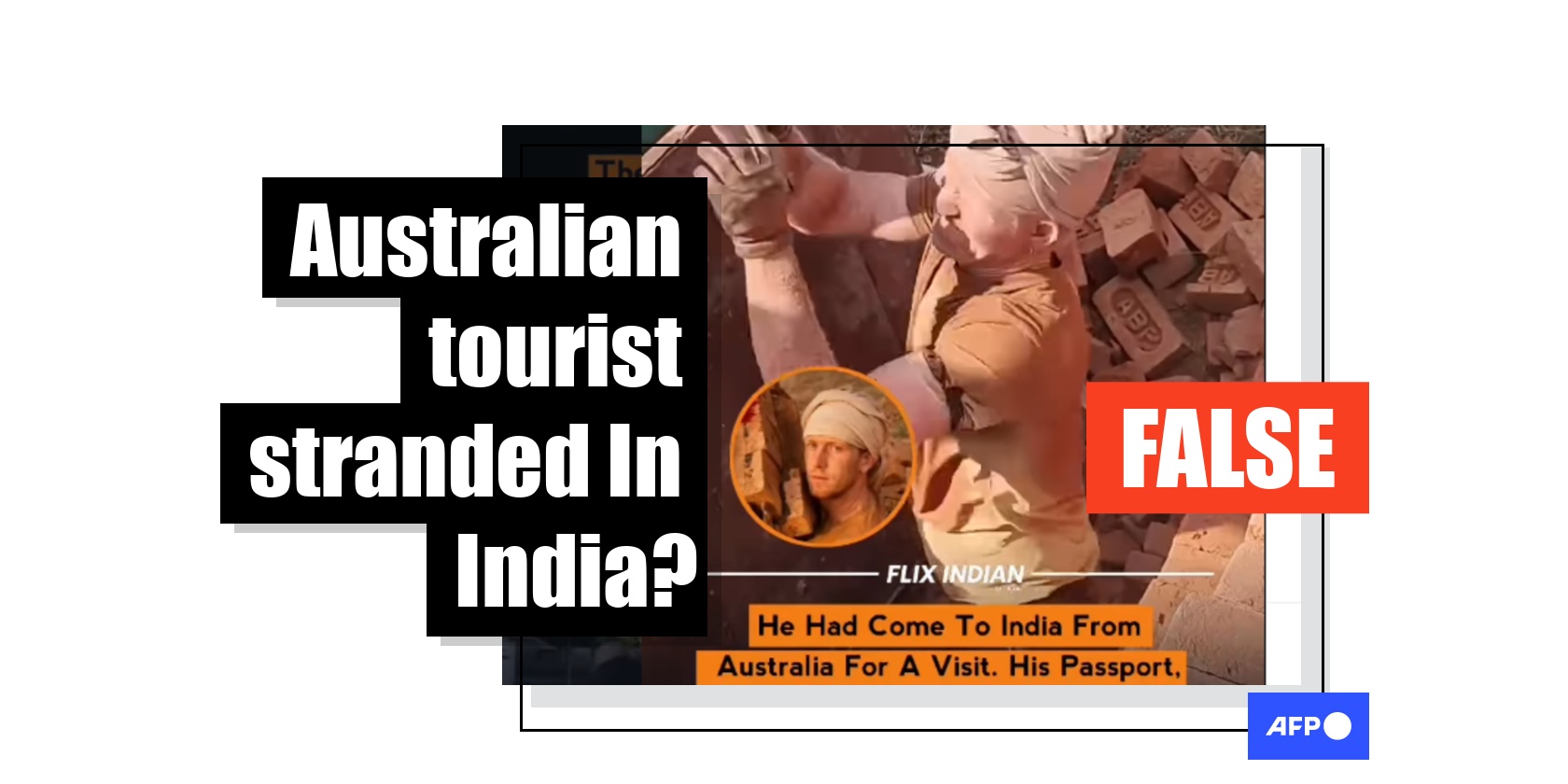
Video falsely claims Australian forced to work at Indian brick kiln
- Published on July 8, 2026 at 10:01
- 3 min read
- By Devesh MISHRA, AFP India
Concerns about the safety of foreign tourists in India are a recurring topic, but a video claiming to show an Australian citizen being forced to work at a brick kiln in eastern Agra city is misleading. AFP tracked down the individual in the video, who confirmed he is an Indian citizen who suffers from a rare genetic condition.
"Australian citizen Anderson came to India witnessing the beauty of the iconic Taj Mahal in Agra. However, what was supposed to be a memorable trip soon turned into a nightmare when his bag was allegedly stolen, taking away his passport, visa, money, and other important documents", reads the caption of a June 23, 2026 Instagram post.
The post goes on to claim that the video, which has been viewed more than 2.3 million times, shows a fair-skinned man who has been forced to work alongside other labourers at a brick kiln to earn a living.

Concerns about the safety of foreign tourists in India have also been periodically raised by foreign governments. Canada urged its citizens to "exercise a high degree of caution" in India due to the threat of terrorist attacks throughout the country in a June 2026 advisory (archived link here and here)
Last year, the US State Department advised travellers to "exercise increased caution" due to crime and terrorism risks. It specifically warned women not to travel alone, citing reports of sexual assault at tourist sites and in other public places (archived link here and here).
Comments on the false post suggest that some Instagram users believed the claim to be genuine.
One user wrote, "This is a matter of shame for India; government representatives should step forward and help him."
"That is why fewer foreign guests are visiting India; this place is not safe at all", wrote another.
The video was shared elsewhere on Facebook and Instagram alongside similar claims a day after police in India's Eastern Uttar Pradesh state rescued 12 men who were allegedly being held as bonded labourers at a factory.
The workers, including minors, were allegedly confined, physically tortured and forced to work for months under inhuman conditions (archived link).
But the video does not show an Australian tourist being held as a forced labourer at an Indian brick kiln.
A reverse image search using keyframes found the same man featured as "Indian Anderson" in an Instagram video shared on June 25, 2026 (archived link).
The man identifies himself as Sahil Deshwal from Baghpat district in Uttar Pradesh. Deshwal denied that he is a foreigner, as claimed in the clip circulating on social media, and appealed to the public to stop sharing the false claim.
He told AFP on July 2 that he suffers from a medical condition that gives him a very fair complexion and that he works as a labourer at a local brick kiln, where someone recorded a video of him that was later shared online.
"My video is being shared with false claims. I have looked like this since childhood. My skin is completely white, and my hair is golden, which is why people often call me a foreigner. However, the claims being made along with the video are false," Deshwal told AFP.
Deshwal has earlier shared similar videos of himself working at the kiln on his Instagram account (archived here and here).

Jasveer Singh, station house officer of Tajganj Police Station in Agra, told AFP on July 2 that there had been no incident involving an Australian citizen being coerced into forced labour. He dismissed the claim as false.
"No such incident has come to our notice. If a tourist's belongings had been stolen, a complaint would have been lodged with the police," he said, adding that police had "confirmed that the person in the viral video is an Indian citizen, not Australian."
AFP has previously debunked videos misidentifying tourists in India.

Copyright © AFP 2017-2026. Any commercial use of this content requires a subscription. Click here to find out more.
Is there content that you would like AFP to fact-check? Get in touch.
Contact us