
Court figures contradict claims divorce filings surged after South Korean chipmaker bonus payouts
- Published on July 7, 2026 at 10:49
- 3 min read
- By Hawon Jung, AFP South Korea
South Korean chipmaker SK Hynix has agreed to pay huge bonuses to workers as the global AI boom boosted its profits and share prices to new heights, but the new-found wealth has not also led to an 800 percent surge in divorce filings as social media posts claim. The posts shared a purported news article about the supposed surge in Icheon, where SK Hynix has its headquarters, but the figures are not backed up by data from the district court, which saw no significant increase.
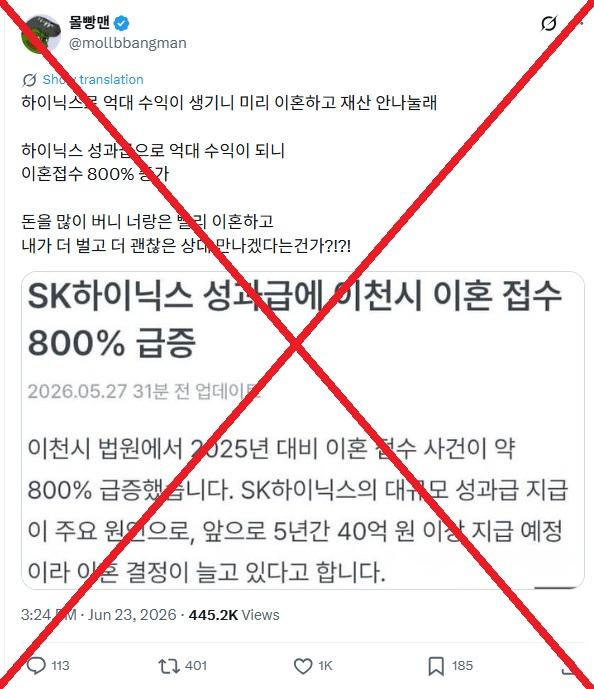
"Hynix brings in six-figure wealth, so people want to divorce early to avoid splitting the assets," says a Korean-language X post shared on June 23, 2026.
Attached to the post is what appears to be a screenshot of a news article, dated May 27, which reads: "The number of divorce filings at the Icheon city court has surged by 800 percent compared to 2025.
"The main culprit is the massive performance-based bonuses from SK Hynix. With the amount of bonuses expected to be more than four billion won (US$2.6 million) for the next five years, more people are deciding to get a divorce."
Similar claims were also shared elsewhere on Instagram, Threads and YouTube as South Korea's Samsung Electronics and SK Hynix -- the world's largest and second-largest memory chipmakers -- saw profits and share prices skyrocket, as frenzied demand for AI infrastructure squeezes the global supply of chips.
There had been growing calls from labour unions to share the massive profits, and SK Hynix agreed in September 2025 to earmark at least 10 percent of its operating profit for bonuses for its 34,000 employees for the next 10 years (archived link).
The Icheon-based company -- which dethroned Samsung Electronics as the most valuable company on the Seoul stock market in June -- saw its operating profits double in 2025 to a record high of 47 trillion won (archived here and here).
Samsung also announced a massive bonus package in May under a deal struck with labour unions to avert a threatened strike, with employees of the technology giant's chip division expected to get an average bonus of up to 600 million won in 2026 (archived link).
That dwarfs South Korea's median annual salary, which the tax agency put at 34.1 million won (archived link).
Comments on the circulating posts, such as "too much money ruins partnerships and families" and "the Hynix employees have so much money and want to start a brand new life", suggest many social media users believed the claim that the area had seen a surge of divorces.
But the financial windfall has not been accompanied by more divorces in Icheon, as the posts claim, and there have been no official reports about an uptick of marital strife in the region.
No significant increase
According to data from the national statistical agency, there were 456 divorces in Icheon in 2025 (archived link).
If the number of divorces increased by 800 percent, as claimed on social media, the city would have reported more than 1,300 divorces from January to April 2026.
A spokesman for the district court that oversees Icheon, Yeoju and Yangpyeong county, however, told AFP they had seen no significant increase in the number of family-related cases -- a category that covers divorce, child custody and family inheritance disputes.
The spokesman said in a July 6 email that 135 new family-related cases were filed from January to April 2026 at the Yeoju branch of the Suwon District Court (archived here and here). There were 92 such cases during the same period in 2025, and 128 in 2024.
There were also 38 out-of-court settlements for family disputes during the first four months of 2026, unchanged from the same period in 2025, the spokesman added.
The court did not provide a break down for each type of dispute or where the disputes originated.
Nam Yun-min, professor of social studies education at The Kongju National University, says the claim reflects public discontent over South Korea's rapidly widening wealth gap and shows how some people are alleviating their frustration through the false narrative (archived link).
"Narratives like this, despite being outlandishly false, appear to give some people a certain sense of relief that 'money is not everything' or 'look what happens when you have too much money'," Nam told AFP on July 6, describing the false claim as a psychological "coping mechanism".
"Some fake claims are created and shared with certain political purposes, while others are created and shared because they resonate with the public sentiment of late -- and this is a prime example of the latter," he said.
Copyright © AFP 2017-2026. Any commercial use of this content requires a subscription. Click here to find out more.
Is there content that you would like AFP to fact-check? Get in touch.
Contact us