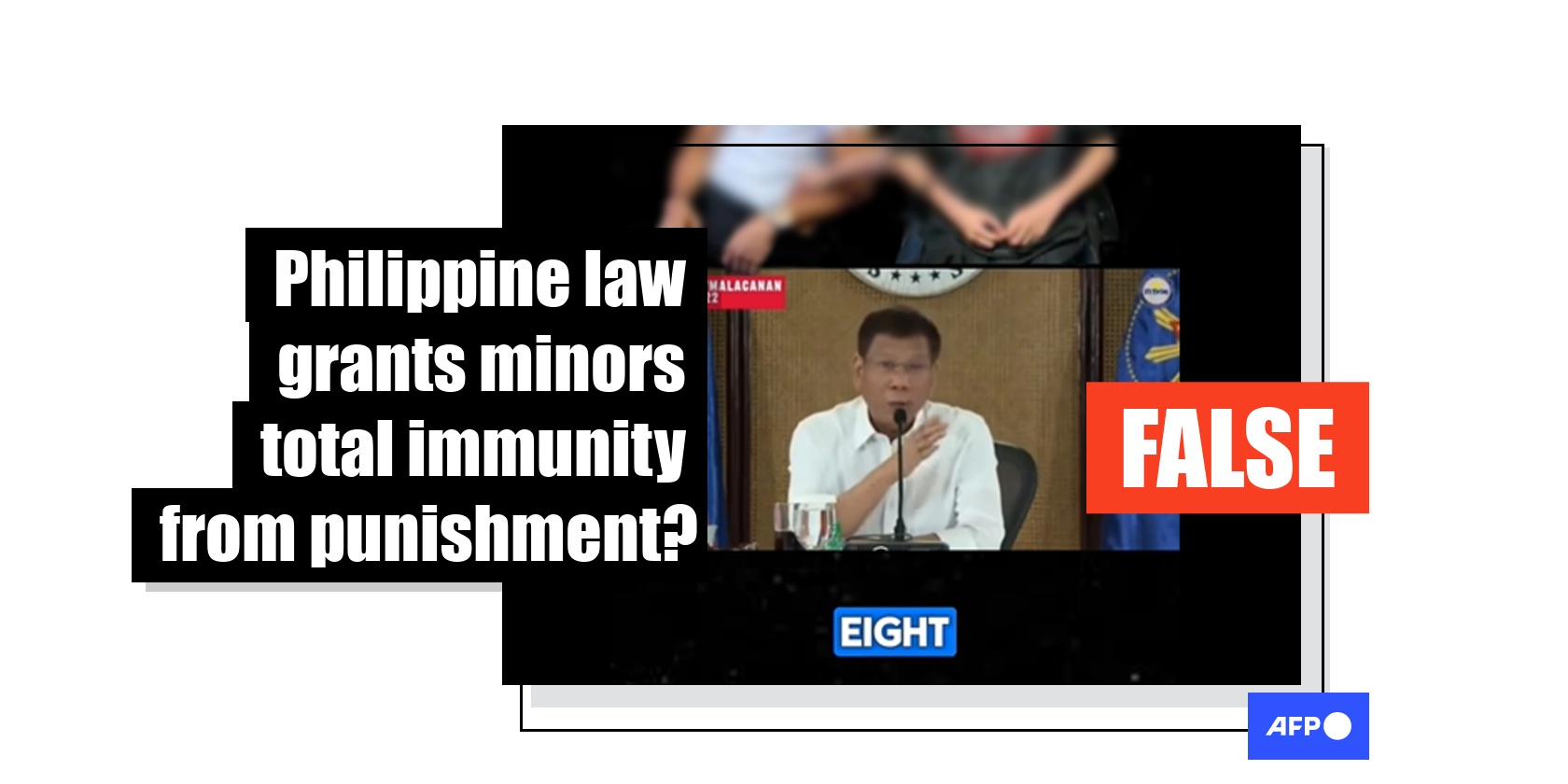
Misleading claims about Philippine juvenile justice law spread after rare school shooting
- Published on July 1, 2026 at 07:09
- Updated on July 1, 2026 at 12:22
- 4 min read
- By Ara EUGENIO, AFP Philippines
Philippine law does not exempt minors accused of a crime from legal liability, contrary to false claims circulating online after two teenagers were arrested for a fatal shooting at a school in June 2026. While they will undergo different legal procedures, they still face the prospect of long-term rehabilitation or in some situations are charged as adults.
"Under the Pangilinan law -- you don't get jailed... That increased the number of crimes tenfold," says a June 23 Facebook post, referring to the Juvenile Justice and Welfare Act 2006 that was co-authored by Senator Francis Pangilinan (archived link).
The law established a specialised justice system for children and teenagers under 18 accused of a crime.
The post includes a video of former president Rodrigo Duterte speaking about the law in 2022, saying: "If a 15-year-old enters your house, stabs you, kills you, and takes your money, when they get to the station the police will just say, 'Oh, reported and recorded, go do what you want'."
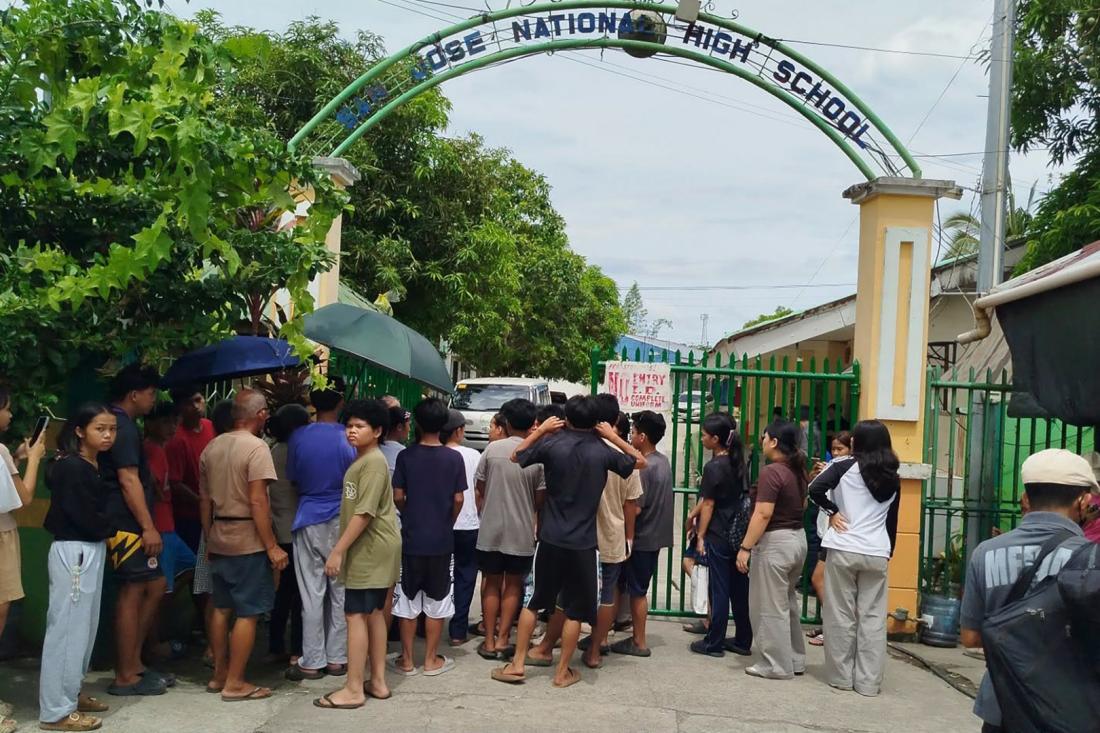
The post also shares pictures widely circulating online showing the two teen suspects in a rare Philippine school shooting at San Jose National High School in the central Philippine city of Tacloban, which killed three students and injured 20 others (archived link).
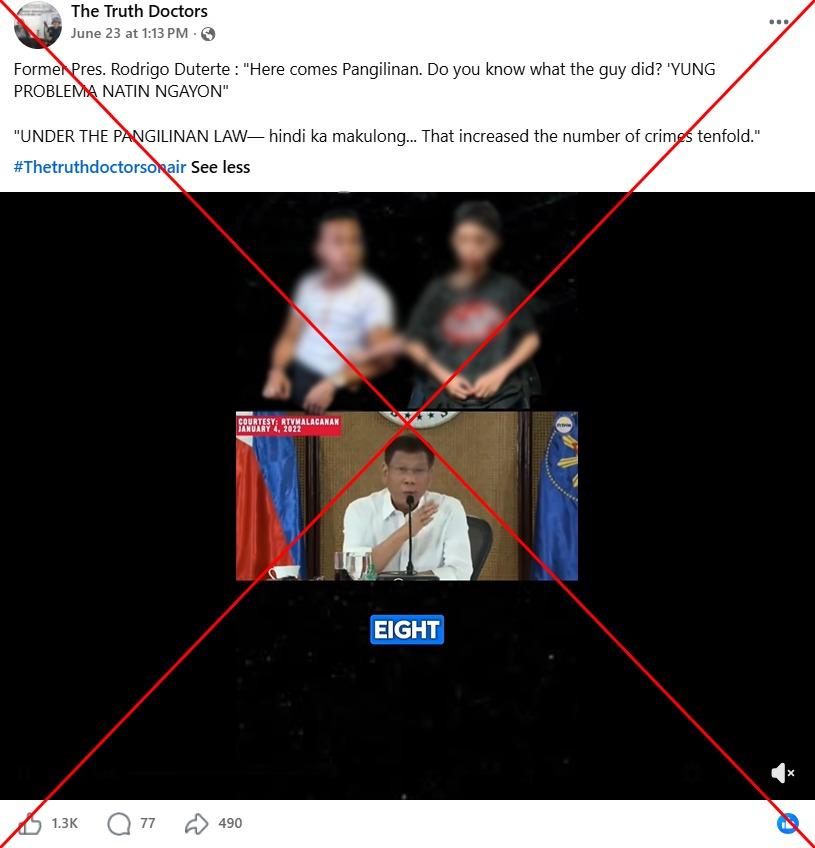
The claim spread in similar posts across Facebook in the days after the Tacloban shooting.
Police said the pair -- aged 14 and 15 -- planned the attack in advance, though the motive has yet to be determined, with bullying and possible "online influences" being considered (archived link).
The case has since renewed criticism of the juvenile justice system and sparked calls to lower the age of criminal responsibility (archived link).
Reactions from users who responded to Duterte's resurfaced remarks suggest they believe the law in fact allows crime suspects under the age of 18 to walk scot-free.
"Sad but true, how come this law was passed? That's why there are many minors who are not afraid of committing crimes," one user commented, while another said: "Former president Duterte has never said anything that didn't turn out to be true or accurate. This is Pangilinan's fault."
But in the aftermath of the shooting, police have charged the 15-year-old suspect with murder, attempted murder and multiple counts of serious physical injuries, and he will face trial if it is proven he was capable of "discernment" as required under the juvenile justice law (archived link).
Brigadier General Jason Capoy, regional director of the Philippine National Police in Eastern Visayas, said in a press conference on June 27 that "the law is clear" (archived link).
"If the involved is already 15 years and one day old, he is already considered above 15, so he will undergo and most probably, if social welfare authorities sees he acted with discernment, he will undergo regular trial, formal trial, but of course, while observing child protection protocols. The other one [14 years old] mandatorily, will be committed to a child protection facility."
Both are being held in secure youth care facilities under the supervision of police and social welfare authorities.
Data from the Juvenile Justice and Welfare Council shows a general decline in cases involving children in conflict with the law over the years, contradicting Duterte's claim of a surge in youth crime (archived link).
Legal experts have also told AFP the former president's remarks misrepresent how the law treats minors who commit crimes.
No 'free pass'
The Juvenile Justice and Welfare Act stipulates that while minors accused of a crime are exempt from criminal liability, they still face different legal procedures and civil liabilities.
"Children do not receive a 'free pass' simply because they are below the minimum age of criminal responsibility," Maria Luisa Villarin, deputy executive director of the Humanitarian Legal Assistance Foundation, told AFP on June 24.
The juvenile justice system instead recognises that children must still be held accountable but in a manner appropriate to their age and developmental capacity, she explained.
Children aged 12 and below are not subjected to criminal prosecution but instead undergo mandatory intervention programmes supervised by social welfare authorities, which may include counselling, psychological assessment, educational support or placement in a child-caring institution.
"For children who are more than 12 years old but not more than 15 years old and who commit the serious offences enumerated under the law, accountability is even more intensive," Villarin said, noting that while they remain exempt from criminal liability because of their age, they may be placed in secure youth care facilities for long-term rehabilitation.
Villarin added that minors aged over 15 to under 18 are assessed to determine whether they "acted with discernment". Those found to have done so may face criminal proceedings under the regular juvenile justice system if diversion is not available or proves unsuccessful.
AFP debunked a similar claim in June 2025, which circulated after two 17-year-olds were convicted for the murder of two others and falsely claimed they would not be held criminally liable under the law as they were minors, but they were in fact jailed for at least 18 years (archived link).
The pair was initially placed in youth facilities before being transferred to adult prisons upon turning 18.
Rommel Alim Abitria, a criminal law expert, told AFP at the time the law clearly demonstrates accountability, citing a previous case that earlier became a lightning rod for misinformation about the legislation, in which minors were found to have acted with discernment and were tried, convicted and sentenced to lengthy prison terms.
He also noted children as young as nine were jailed as adults before the law was passed, which exposed them to abuse, criminal influence and trauma.
"It’s important to note that this was never about excusing wrongdoing -- it's about making sure children are held accountable in a way that reflects their age, capacity and potential for reform," he said.
Corrected paras 3, 17 and 22 to clarify law's mandateJuly 1, 2026 Corrected paras 3, 17 and 22 to clarify law's mandate
Copyright © AFP 2017-2026. Any commercial use of this content requires a subscription. Click here to find out more.
Is there content that you would like AFP to fact-check? Get in touch.
Contact us