'Hungarian Maidan': disinformation from a Russian playbook ahead of Hungarian elections
- Published on May 19, 2026 at 10:00
- 10 min read
- By Ede ZABORSZKY, AFP Hungary
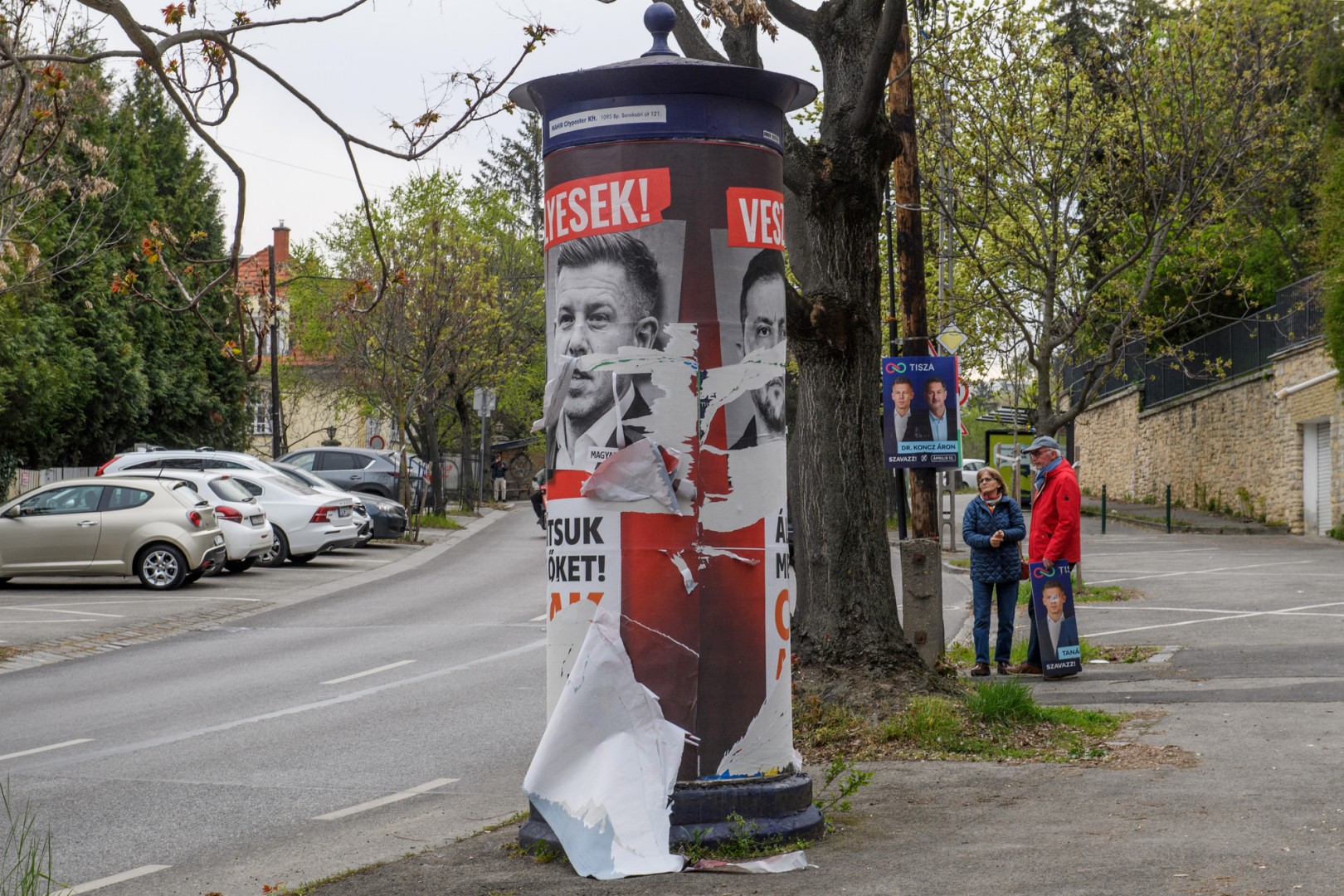
In the run-up to Hungary’s April 2026 parliamentary elections, media outlets favourable to Prime Minister Viktor Orban, Russia-aligned channels and social media influencers had all been pushing a narrative that the opposition – with the help of Ukraine – would orchestrate a bloody uprising afterwards. In fact, on voting day itself, April 12, 2026, public media broadcast a report claiming that, if Orban and his Fidesz party – who had ruled for the previous 16 years – were to hang on only by a slim majority, Kyiv would "try to incite a bloody uprising with snipers and drone operators" reminiscent of the "Maidan" protests that had rocked Ukraine back in 2014. The aim, experts told AFP’s Hungarian-speaking fact-checking team in an investigation conducted as part of the HDMO project, would be to discredit anyone who questioned the election results. But when the scale of the landslide victory of Peter Magyar and his opposition Tisza party became clear, that narrative immediately became obsolete and abruptly disappeared.
A search for the term "Maidan" in the disinformation database of the EU project EUvsDisinfo yielded more than 900 hits, mostly in accounts tied to Russian sources. A closer examination suggested that it was a well-used tactic for Russia‑aligned disinformation actors to label any political event that ran counter to Russia’s interests as "Maidan".
The Euromaidan Revolution – or Revolution of Dignity – was a series of protests in Ukraine in 2013–2014. The epicentre of the movement was Independence Square in Kyiv, which became colloquially known as Euro Square, or "Euromaidan" in Ukrainian. One of the main reasons behind the protests was the decision by pro‑Russian government of President Viktor Yanukovych to pursue stronger ties with Russia and veto legislation that would have moved Ukraine closer to the European Union.
The crackdown on protesters by the Moscow-friendly government led to violent clashes in Kyiv and other Ukrainian cities which left more than 100 protesters and over a dozen police officers dead. The protests ended with the pro-Russian government fleeing the country.
According to the Russian narrative, the Revolution of Dignity was a "foreign‑backed coup" led by the "West" and "Ukrainian Nazis". As a reaction to the regime change, Russia annexed the Crimea and also backed pro-Russian separatists in East-Ukraine leading to the Russian-Ukrainian war and eventually the full-scale invasion of Ukraine in 2022.
And since this original event, Russia and Russia-aligned actors worldwide routinely labelled any kind of event that went against the Kremlin's will as "Maidan", be it protests in Belarus, Serbia or Georgia. If one examines the various manifestations of the "Maidan" narrative, a pattern emerges: according to them, any dissatisfaction with a pro-Russian government, or any protest against Russian interference in a country’s internal affairs, is necessarily artificially incited from outside.
As AFP's Hungarian fact-checking team reported in multiple articles in the month of the election (here and here), it is clear that actors utilising Russian-style disinformation tactics were active in Hungary ahead of the parliamentary elections. Experts also warned ahead of the elections that Russia might try to influence the outcome in favour of Orban, the Kremlin's strongest ally in the European Union, whom Russian president Vladimir Putin personally endorsed.
Anti-Ukrainian disinformation was one of the main pillars of the campaign of Fidesz. The messages used by Fidesz politicians and media often organically overlapped with the Russian narrative, so it is hard to tell how much of the "Hungarian Maidan" narrative was inspired by Russia. But in the months prior to the election claims about Ukraine-backed violent uprising in Hungary became increasingly prominent and reached their peak on election day itself, AFP research has shown.
An early example found by AFP was from January 14, 2026 when the pro-Fidesz news site Origo published an article calling Tisza Party leader Peter Magyar "Peter Maidan" six times in a text of barely over 400 words.
On February 27, 2026, social media influencer Adam "Fair Right" Varga, also affiliated with Fidesz, posted a short video on YouTube with the title "Tisza is preparing for civil war in the event of the fall of Peter Magyar." In the video, the content creator claims that the opposition is preparing a "Hungarian Maidan" and wants to start a civil war if Fidesz wins the elections.

Up until the final hours of the election, the Maidan narrative in Hungary continued to escalate, only to disappear abruptly the very moment Orban conceded defeat.
Experts told AFP that the disinformation campaign was likely linked to a decline in support for Fidesz, and was intended to discredit possible protests and allegations of electoral fraud in the event that they had managed to win against all expectations. But after Fidesz’s disastrous defeat, there was no point in keeping the “Hungarian Maidan” story alive. The Tisza Party won a record 141 seats in the new 199-seat parliament – a two-thirds majority. Experts say that pushing the Maidan narrative after such a clear victory would have been counterproductive.
The rise of the 'Hungarian Maidan' narrative
In the months leading up to the vote, most independent polling companies showed a huge lead for Tisza, and only institutions with ties to Orban's party projected a Fidesz victory. Median and 21 Kutatokozpont predicted the actual election results with a very high accuracy, while those close to Fidesz showed a margin error of over 20 percent.
However, until the very last minute, Fidesz and its allied media dismissed all independent polls as "lies" and "election interfering". In an unprecedented Facebook post in February 2026, Orban himself called the director of Median "the greatest joker" after the polling company reported an 11-percent lead for Tisza.
AFP talked to experts in the field of disinformation and national security, who explained that this gap between actual public opinion and Fidesz’s own narrative – according to which an opposition victory was impossible – may have contributed to the emergence of the "Hungarian Maidan" narrative. Under this plan, any public unrest could have been portrayed as a Ukraine‑orchestrated coup against Hungary's lawful government.
This kind of planning – where an actor orchestrates an act with political consequences (such as a terror attack, for example) and deliberately attempts to frame another country – is also known as a false flag operation.
According to national security expert Peter Buda, "the leaders of the government party were also aware that victory could be achieved practically only through electoral fraud, that is, by buying votes" and were afraid that a discrepancy between the public opinion and Fidesz victory might lead to demonstrations and international protests.
"To prevent this, the government has implemented the 'Maidan Plan.' The gist of this plan is that opposition demonstrations will be discredited through violent provocations involving false flag operations that can be traced back to Ukraine", the expert told AFP on April 28, 2026. According to Buda, "to this end, the government’s communication strategy was developed in complete parallel with a disinformation campaign that has been proven to have Russian ties".
Similarly Bulcsu Hunyadi, programme director of the think tank Political Capital, told AFP in a mail on April 22, 2026 that "it is conceivable that the 'Hungarian Maidan' narrative was intended to pre-emptively frame and delegitimise the anticipated Tisza protests, which might have taken place in the event of a narrow Fidesz victory for example, if Fidesz held a majority in parliament despite Tisza winning the popular vote".
"I believe the narrative was spread to preemptively discredit any pro-Magyar protests if Orban did end up performing better than the polls were showing," Alice Lee, Russian influence analyst of NewsGuard, a journalism project that specialises in evaluating the credibility and transparency of websites, told AFP in a mail on May 5, 2026.
Lee also said that it was the first of this type of disinformation narrative that NewsGuard had detected in the EU so far: "I can't say I've seen the classic 'colour revolution' or 'another Maidan' narrative outside ex-USSR countries before. Perhaps the country has to start off being clearly well-aligned with Russia before the 'upheaval' for this narrative to be employed, and the only example of that alignment within the EU has been Hungary."
Already on April 8, 2026, a report by the Institute for Strategic Dialogue (ISD), an independent research institute that analyses extremist movements, disinformation, and online threats warned that Russia has "pushed false claims about Ukraine interfering in the elections and Ukrainian refugees destabilising Hungary".
The pro-Fidesz media site Ellenpont published an article on March 9, 2026 claiming that Ukrainian president Volodmir Zelensky was "planning to incite violent uprising in Hungary" and was already "training armed groups" to this end. The article cited a certain "Ukrainian star journalist" Diana Panchenko. In reality, Panchenko is known for echoing Russian propaganda and disinformation.
A Russian style disinformation video
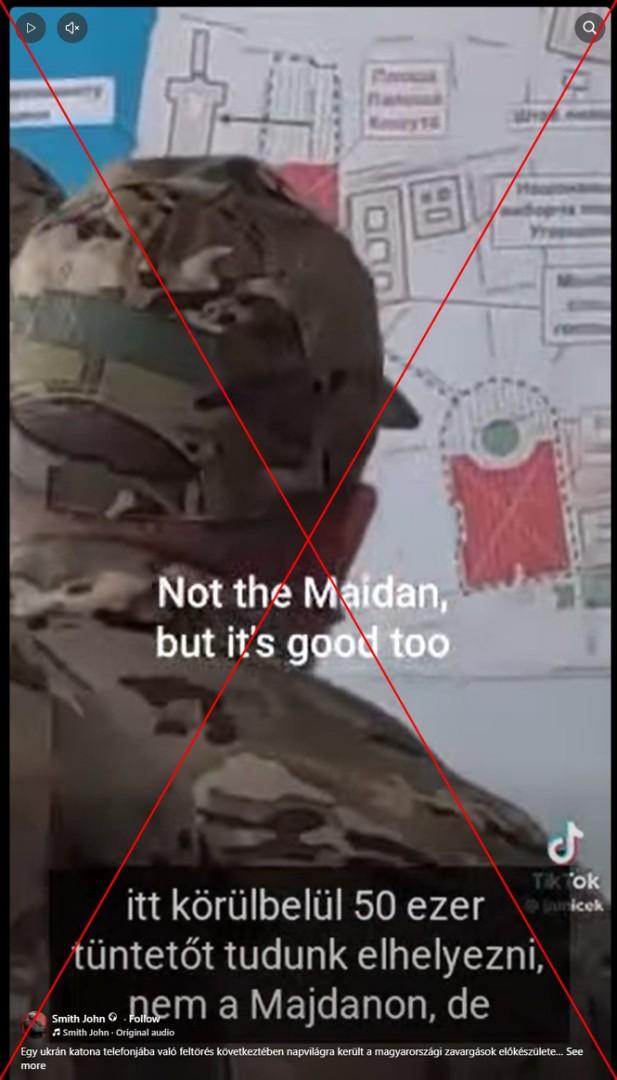
During election week, the "Hungarian Maidan" narrative escalated to a new level with the appearance of a video on Hungarian social media that opens with the text: "Video from a hacked phone of a Ukrainian serviceman." The roughly one‑minute‑long clip shows people in camouflage uniforms discussing plans for violent riots in Budapest, noting that it was "not the Maidan, but it's good too."
Many of the Hungarian examples of the clip can be traced back to a since deleted TikTok video by a Czech user from April 5, 2026. But the same video was available on YouTube at least since April 3, 2026. It also appeared in various languages such as Turkish.
As Peter Buda noted in a blogpost (archived here), it is clear that "the video was fake" and was created solely to support the narrative that Ukraine was planning a violent uprising in Hungary. According to Buda, elements such as the conveniently placed "Budapest map," the way the participants speak, and the explicit reference to the Maidan, clearly indicate that "it is a staged situation."
Both Peter Buda and Bulcsu Hunyadi told AFP that it was evident the Russian disinformation campaign in Hungary was aligned with Fidesz's own disinformation efforts, and that there was no meaningful attempt to conceal the presence of Russian narratives.
However, the Political Capital expert added that this alignment ultimately hurt rather than helped Fidesz. "The majority of Hungarian voters viewed Russian interference as a threat, as opposed to the 'Brussels' and Ukrainian influence that the Fidesz campaign sought to portray."
One of the main claims advanced by Orban's party was that the European Union and Ukraine wanted Fidesz removed from power in order to push Hungary into a war, while Tisza Party promised repairing the ties with Brussels.
'Hungarian Maidan' on election day
As election day drew nearer, the narrative of a "Hungarian Maidan" intensified across pro-Fidesz media outlets and social media platforms.
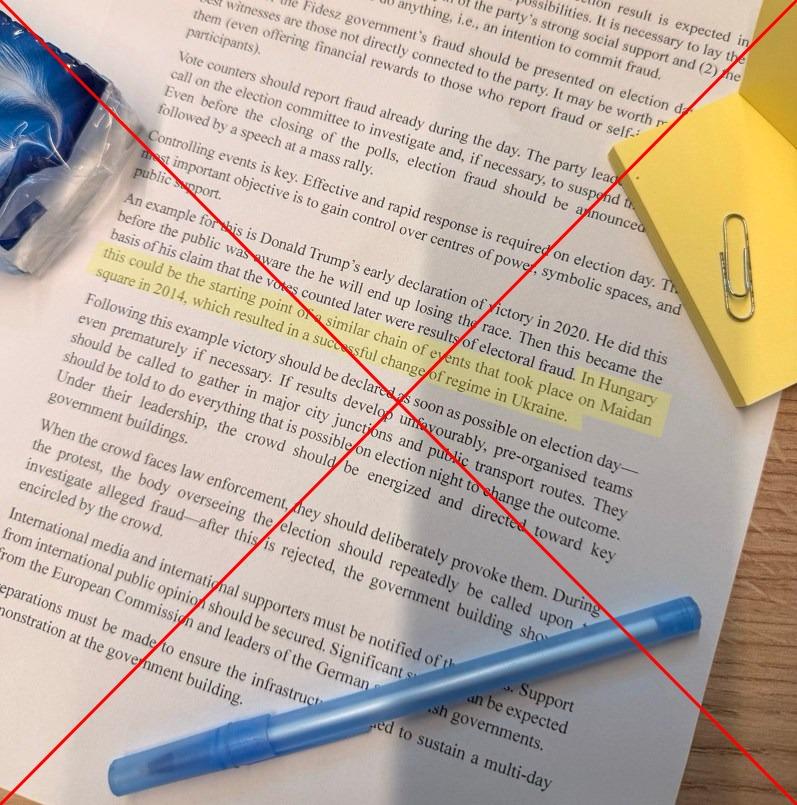
At 11:10 am on election day, the pro-Fidesz website Ellenpont published a new article pushing this claim, citing an alleged internal Tisza Party document presented by Balazs Csercsa, a former "religious affairs adviser" to the party. After leaving Tisza in January 2026, Csercsa became a regular guest on pro-Fidesz media, where he repeatedly spread false and unfounded claims about the party in the months leading up to the election.
The English-language document, titled "Election Day Action Plan," outlines plans for a violent uprising that "could be the starting point for a chain of events similar to the one that took place on Maidan Square in 2014."
At 3:00 pm the same day, Ellenpont published another article with the title "Ukrainian soldiers are planning a bloody coup in Kossuth Square following the defeat of the Tisza Party – we reveal the shocking, expose video!". The article cited the video with the uniformed men discussed above and claim that "Zelensky wants to overthrow the Hungarian government by force, using mercenaries trained by the Ukrainian army's special forces".
With hours left of the voting the news programme of Hungary's public media echoed this narrative without criticism, citing Ellenpont and repeating its claims about an alleged violent coup involving "Ukrainian snipers and drone operators."
The false narrative has made rounds in other languages too, for example on election day a German-speaking user uploaded a video to Facebook where he claimed that the "ukranonazis" were preparing a "Maidan 2.0" in Hungary. The unfounded claim also spread in English on X.
Election defeat and the end of 'Hungarian Maidan'
Shortly after 9:00 pm, Viktor Orban conceded defeat, and the results the same day made it clear that the Tisza Party had won by a landslide, securing a super-majority in parliament. Following this, the narrative of a "Hungarian Maidan" was never mentioned again by the same users and media outlets pushing it earlier, and AFP could not find any example of it despite repeated keyword searches.
Experts told AFP that, following the Tisza Party's landslide victory, it quickly became clear that there was no reason to keep the narrative alive.
"The narrative was abandoned quickly by pro-Orban voices online once results started rolling in that evening, suggesting it was abandoned because of Magyar's decisive victory. Perhaps pro-Orban and pro-Kremlin users simply deemed it too decisive a victory to try to contest," said Alice Lee from NewsGuard. The expert contrasted the situation with Moldova, where a tightly contested 2025 referendum on EU accession narrowly passed only with 50.3 percent support. There, Kremlin-linked sources began circulating false claims about the vote being rigged the week following the referendum.
"As I have emphasised on several previous occasions, false-flag operations generally unfold according to a dynamic narrative, meaning they are tailored to the specific, constantly changing political situation", Buda told AFP. According to the expert, the election results indicated such a high level of rejection of the government that "any form of government resistance would have been counterproductive".
"This is why the prime minister conceded defeat so quickly. The fact that the provocation involving the false-flag operation did not take place is therefore due to the opposition's landslide victory, not to the government's restraint", explained the expert.
Hunyadi Bulcsu also told AFP that "the overwhelming victory of Tisza, which exceeded all expectations, may have rendered any such preliminary attempts at interpretation and potential actions meaningless. They are well aware that information autocracies are only successful as long as they have the support of the social majority behind them, or, even if that support temporarily wanes, can be rebuilt. This is not the case in Hungary at present."
But while this might be the end of "Hungarian Maidan", Peter Buda believes that it is by far not the end of Russian disinformation efforts in Hungary. "As I have mentioned on several occasions prior to the elections, we must also expect that the operation will continue: Russian interference operations are never limited to a single specific event, but rather seek to influence a country's politics over the long term", the expert told AFP.
Copyright © AFP 2017-2026. Any commercial use of this content requires a subscription. Click here to find out more.
Is there content that you would like AFP to fact-check? Get in touch.
Contact us