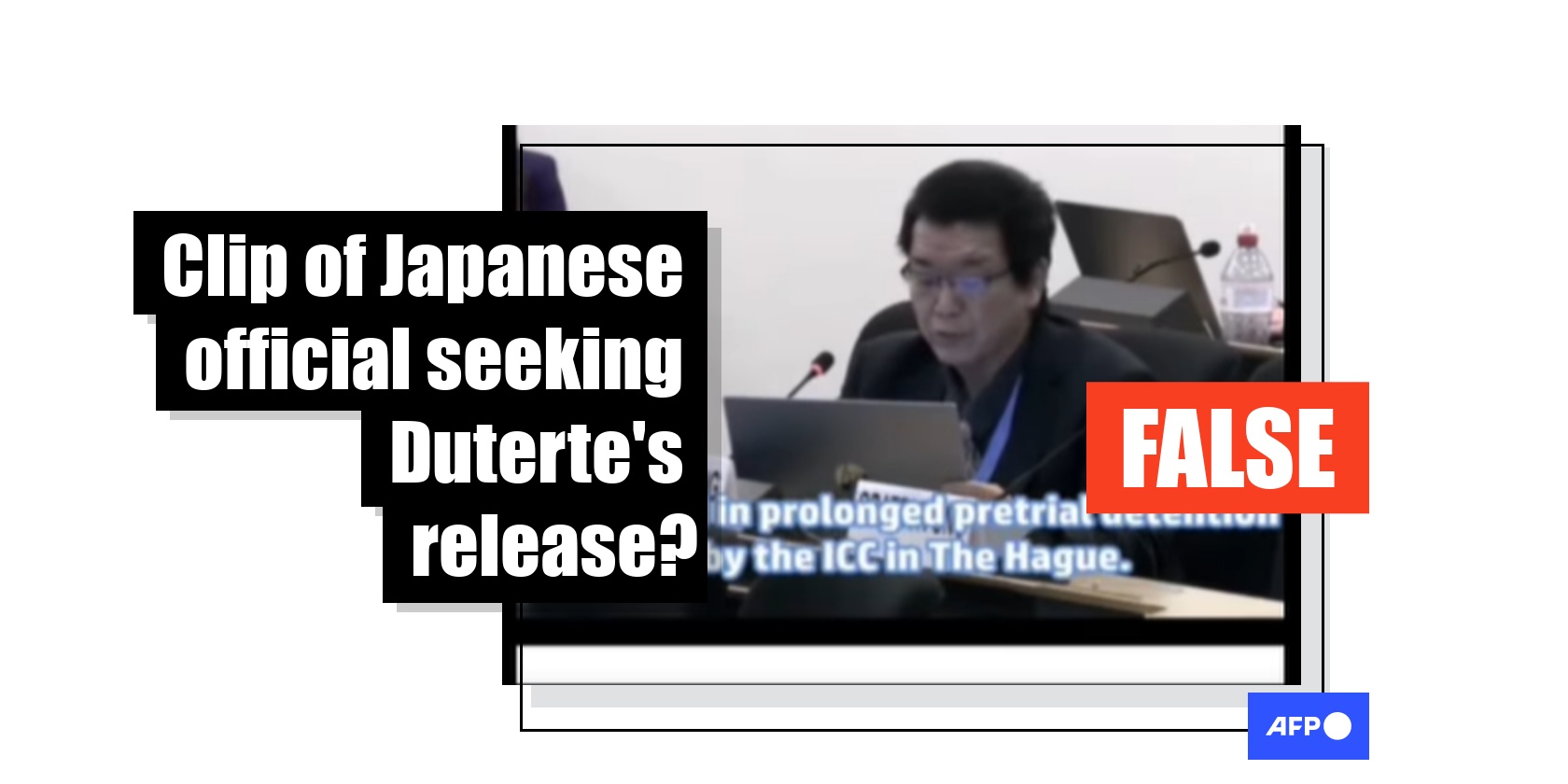
NGO speech at UN falsely touted as Japanese government's call to free ex-Philippine leader
- Published on April 14, 2026 at 09:13
- Updated on April 15, 2026 at 04:46
- 3 min read
- By Ara EUGENIO, AFP Philippines
The Japanese government has not made an official request to seek the release of former Philippine president Rodrigo Duterte from International Criminal Court (ICC) custody, contrary to social media posts falsely sharing a video of a speech at the United Nations as evidence. The man in the clip was presenting the views of a non-governmental organisation registered in Japan, not those from Tokyo.
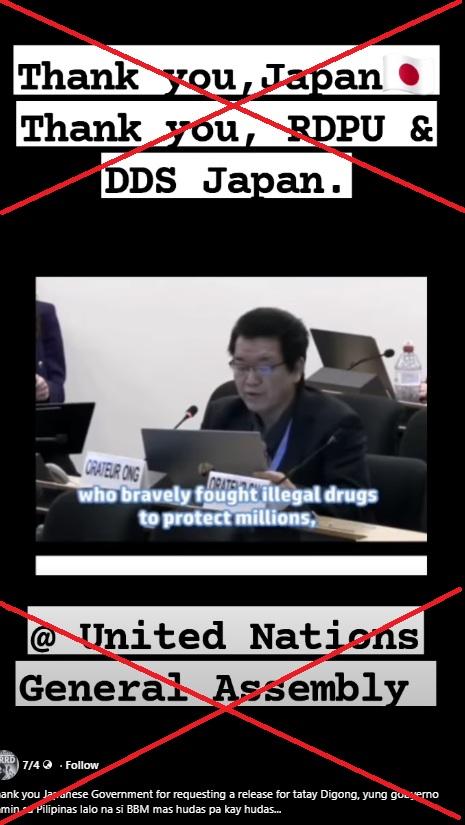
"Thank you to the Japanese government for requesting the release of Tatay Digong. Our government in the Philippines, especially BBM, is more of a traitor than Judas himself," reads an English and Tagalog-language Facebook post shared on March 15, 2026, using Duterte and President Ferdinand Marcos's popular nicknames.
The post includes a video of a man calling for Duterte's release from ICC detention, with overlaid text claiming the speech took place at the United Nations General Assembly.
"This over one-year pre-trial detention raises profound questions about compliance with the Rome Statute's guarantees of humane treatment and a speedy trial," says the man, identified as a "representative for the International Career Support Association".
"It is an affront to human dignity and the abuse of international justice for political ends. We urge this council to demand a humanitarian review and the interim release of president Duterte."
The false claim circulated as the 81-year-old Duterte -- who once vowed to pardon authorities involved in a drug war that rights groups say killed thousands -- remains in detention at The Hague.
ICC pre-trial chamber judges have up to 60 days to issue a verdict following the February 27 conclusion of hearings into whether the former Philippine president will face trial for crimes against humanity (archived link).
The court has previously rejected appeals for his release on health grounds, ruling that his legal team had not established sufficient precautions to warrant a temporary release from custody (archived link).
The claim has circulated across social media, triggering comments praising the Japanese government for supposedly calling for Duterte's release.
"Thank you Japan for being a voice for the Filipino people," one comment read.
Another said: "Other countries have it better -- they still have a heart and they don't surrender their sovereignty."
However, AFP cannot find credible media reports of a Japanese government official making such comments at the UN or through any other diplomatic channels as of April 14.
'Special consultative status'
A combination of reverse image and keyword searches on Google found the misrepresented clip matches a section of a video titled "27th Meeting - 61st Session of Human Rights Council" uploaded to the United Nations archives on March 11 (archived link).
The Human Rights Council is a body of 47 member states focused on human rights issues (archived link). It is separate from the UN General Assembly, the organisation's main policy-making organ where all 193 member states are represented (archived link).
The video's description identifies the man speaking in support of Duterte as Shunichi Fujiki of the International Career Support Association (ICSA) -- not a representative of the Japanese government.
The ICSA is a private non-governmental organisation (NGO) registered in Japan's western Nara prefecture that advocates for a range of social development issues, including employment and human rights (archived link).
"As an international NGO, we have not received even one yen from the Japanese government and local governments," its official website says.
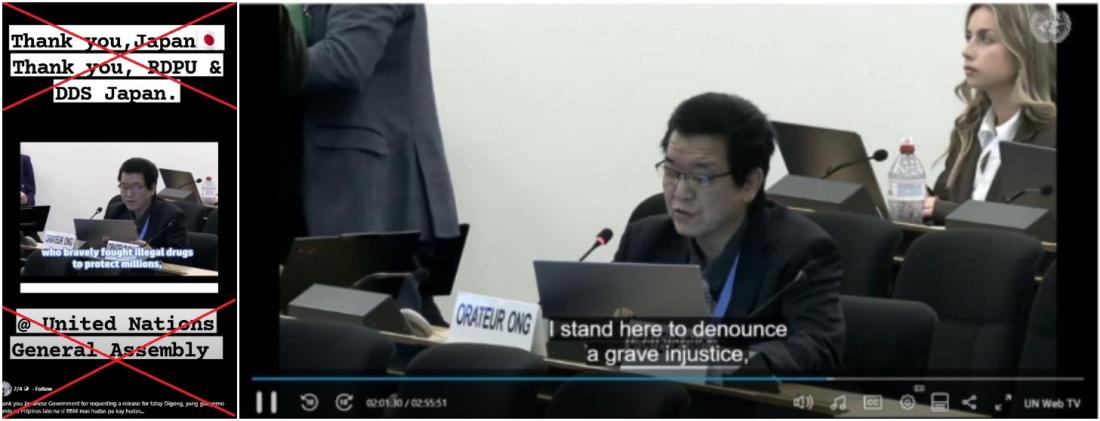
A copy of the statement received by the UN describes the group as a "non-governmental organisation in special consultative status" (archived link).
This designation is granted to smaller NGOs with expertise in specialised fields, allowing a group like the ICSA to attend meetings and contribute to UN discussions (archived link).
However, it does not mean they represent the Japanese government or that the UN officially endorses their views.
Japan's embassy in the Philippines also told AFP via Viber on April 15 that the ICSA representative "did not speak at the United Nations on behalf of the Japanese government".
AFP has debunked other false claims related to Duterte's case.
Updated with the Japanese embassy's comment.April 15, 2026 Updated with the Japanese embassy's comment.
Copyright © AFP 2017-2026. Any commercial use of this content requires a subscription. Click here to find out more.
Is there content that you would like AFP to fact-check? Get in touch.
Contact us