
Misinformation targets reforms against hate speech in Canada
- Published on April 9, 2026 at 20:21
- 3 min read
- By Marisha GOLDHAMER
- Translation and adaptation AFP Canada
Canada's Senate is debating a bill passed in the House that proposes changes to the criminal code to strengthen penalties for hate speech. But while groups have raised concerns about the elimination of exemptions for religious speech made in "good faith," the Justice Ministry and an independent expert rejected online claims that the legislation has criminalized scripture, telling AFP that the bar for what constitutes hate speech has been set intentionally high based on court rulings.
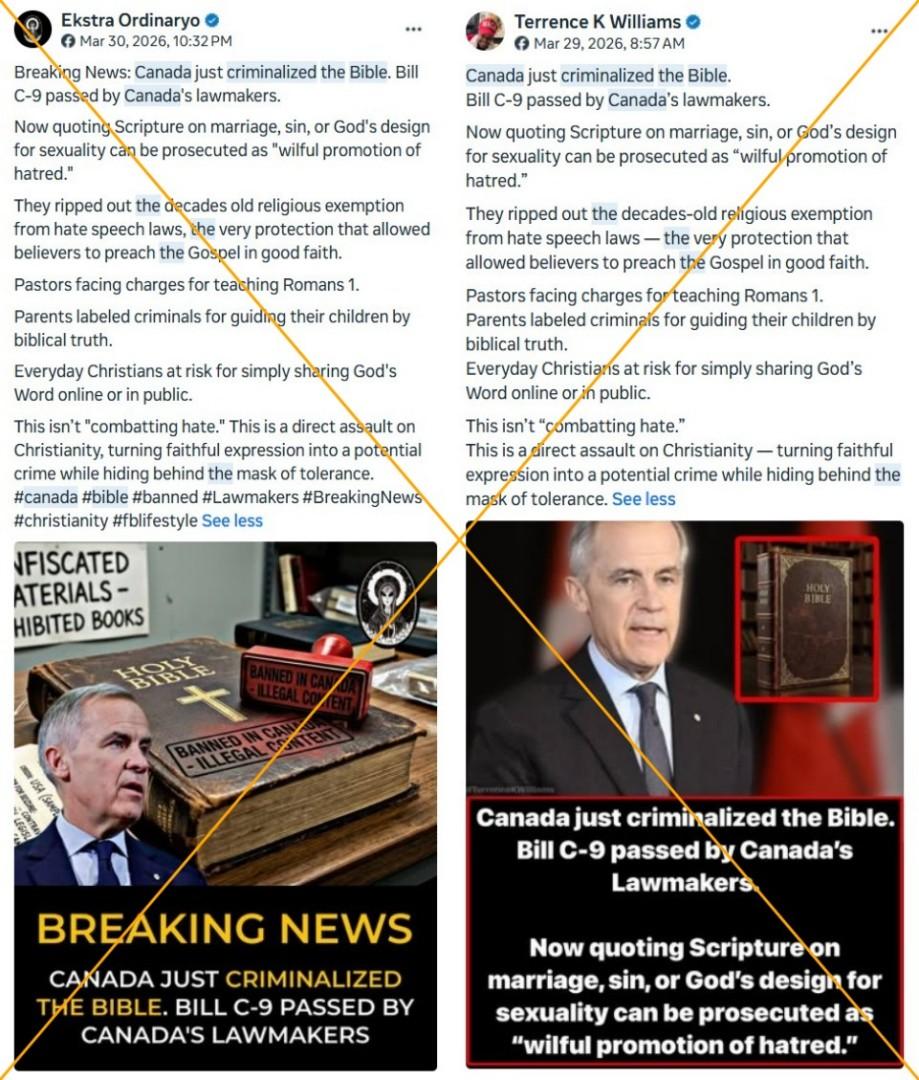
"Canada just criminalized the Bible. Bill C-9 passed by Canada's lawmakers," says a March 29, 2026 Facebook post from conservative US comedian Terrence K Williams, whom AFP has fact-checked multiple times for spreading false claims.
"Now quoting Scripture on marriage, sin or God's design for sexuality can be prosecuted as 'wilful promotion of hatred.'"
Similar posts, many depicting Prime Minister Mark Carney next to the Bible, spread across Facebook, Instagram, Threads and X. The claim also circulated on video-sharing platforms such as TikTok, YouTube and Rumble.
The posts gained traction as Bill C-9 -- the Combatting Hate Act (archived here) -- passed Canada's House on March 25.
The bill must still be approved by the Senate and receive Royal Assent before becoming law. The Senate completed the first of three readings March 26 (archived here).
The legislation proposes several reforms to Canada's Criminal Code, which already includes penalties for incitement and the promotion of hatred (archived here and here). The reforms would add language to "codify a definition of 'hatred' to clarify when conduct constitutes a hate crime" and make it easier to prosecute such crimes (archived here).
The bill's supporters say the changes are necessary to combat rising antisemitism, Islamophobia, homophobia and transphobia (archived here, here, here and here).
But contrary to the claims online, freedom of religion is protected under the Canadian Charter of Rights and Freedoms (archived here and here). Justice Minister Sean Fraser has said publicly that Bill C-9 "will not criminalize faith" (archived here).
In a December 9, 2025 statement, he said prosecuting hate speech offenses "is designed to capture only the most dangerous, dehumanizing forms of expression" (archived here).
Ian McLeod, spokesman for the Department of Justice, reiterated that stance in an April 2, 2026 email to AFP.
"Hatred is a high threshold involving vilification and detestation," McLeod said. "Religious sermons, texts and teachings delivered in good faith, including the Bible, would not meet this standard."
He said Bill C-9 introduces a definition of hatred, based on rulings from the Supreme Court of Canada, to "clarify what constitutes a hate crime or hate speech." He also said the bill specifies "what is not hatred, namely acts that discredit, humiliate, hurt or offend."
McLeod said the bill also includes clauses "to make clear that the offences only capture expression communicated with the intention to promote hatred or antisemitism."
Richard Moon, professor emeritus of law at the University of Windsor, told AFP on April 3 that courts have narrowly defined the offense to focus on "extreme speech" or "speech that amounts to the vilification, the detestation of the members of the group" (archived here).
"The examples they give are things like describing the members of a group as subhuman, as animalistic, as inherently violent," he said.
He said it was "plainly wrong" to claim people will not be able to discuss the Bible.
Religious exemption
The Bloc Québécois joined the Liberals, over the objection of the Conservative Party (archived here), to pass Bill C-9 after an amendment to remove the religious exemption from Canada's criminal code was accepted.
Failed previous attempts to remove the exemption by Bloc leader Yves-François Blanchet were also met with misinformation.
As it is written, Section 319(3)(b) of the code says a person shall not be convicted "if, in good faith, the person expressed or attempted to establish by an argument an opinion on a religious subject or an opinion based on a belief in a religious text" (archived here).
The elimination of this language has raised concerns from Catholic and Muslim leaders (archived here and here).
Anaïs Bussières McNicoll, lawyer and director of the Fundamental Freedoms Program at the Canadian Civil Liberties Association (archived here), told AFP that the removal of the section without alternative language "could lead to the persecution of some religious minorities."
She said in an April 8 email that despite religious freedoms outlined in Canada's Charter, "a state authority could adopt an excessively negative interpretation of some religious sermons and teachings" under the proposed changes.
Justice Minister Fraser, however, has argued that "in nearly 20 years of this defense existing, we are not aware of a single case in which courts relied on section 319(3)(b) to acquit an accused."
Read more of AFP's fact checks from Canada here.
Copyright © AFP 2017-2026. Any commercial use of this content requires a subscription. Click here to find out more.
Is there content that you would like AFP to fact-check? Get in touch.
Contact us