New York plane crash reignites 9/11 conspiracy theories
- Published on March 26, 2026 at 22:08
- 4 min read
- By Bill MCCARTHY, AFP USA
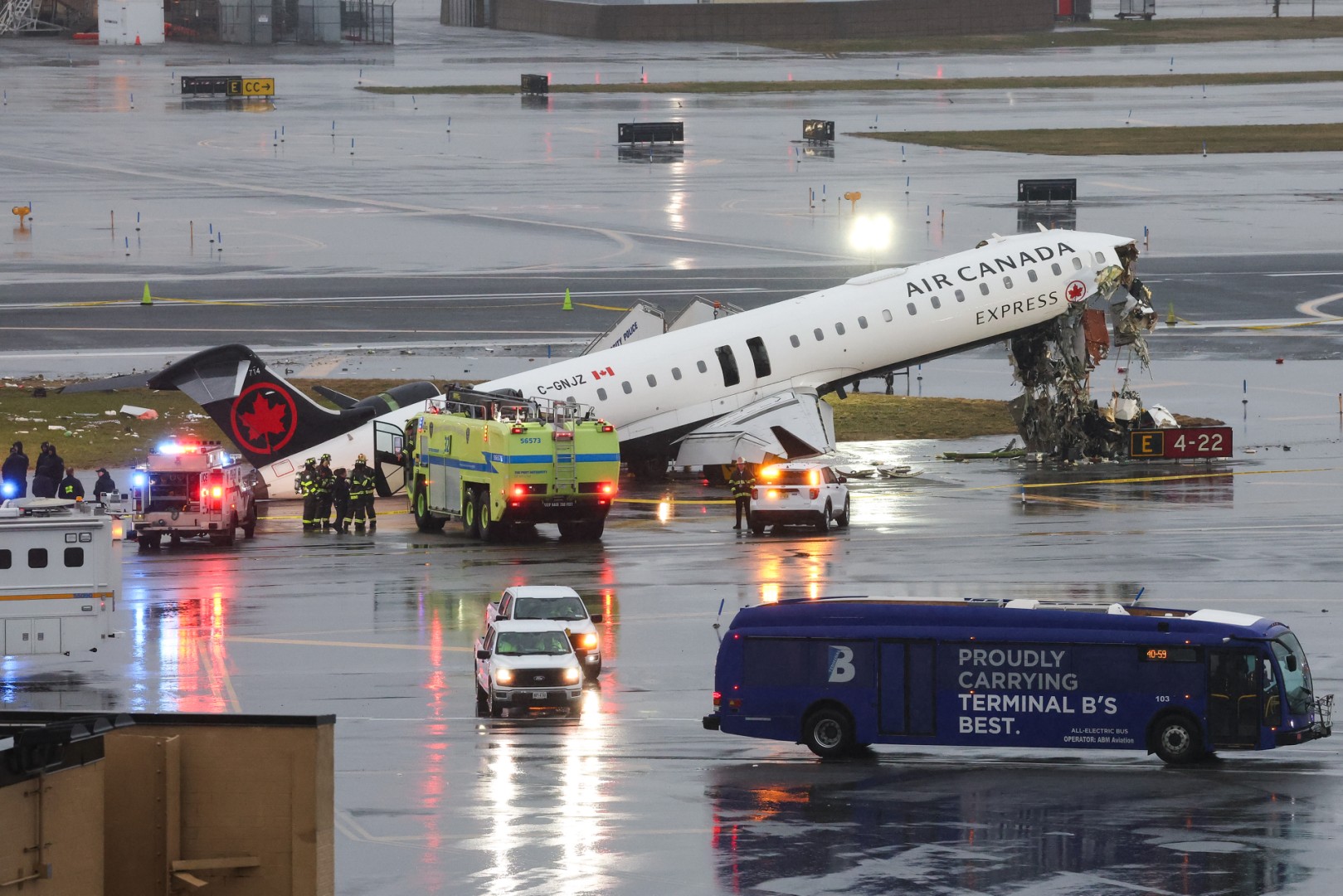
A deadly crash between an arriving aircraft and a fire truck at New York's LaGuardia airport reignited long-debunked conspiracy theories about the September 11, 2001 attacks on the World Trade Center, with online disinformers claiming the damage to the Air Canada plane's cockpit proves the jets hijacked by Al-Qaeda could not have brought down the Twin Towers. But official investigations have consistently attributed the collapse of the skyscrapers to the impact of the planes -- which were larger and moving much faster than the Air Canada aircraft on the runway -- combined with the roaring, multifloor fires ignited by the burning jet fuel.
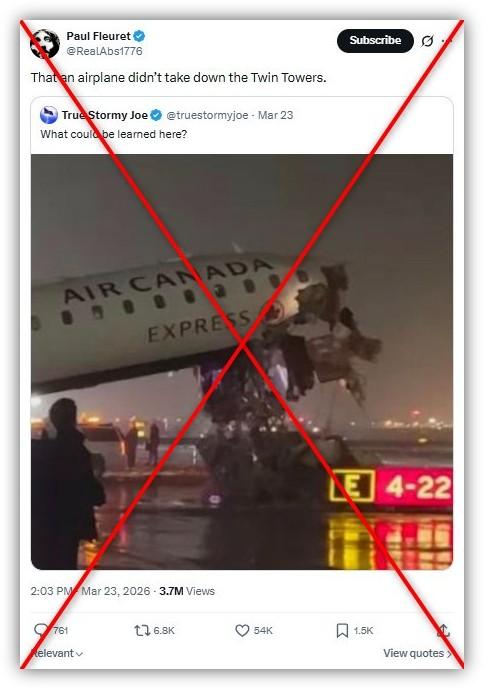
"What could be learned here?" asks a March 23, 2026 post on X, showing a photo of the crash at LaGuardia.
Another user responded: "That an airplane didn't take down the Twin Towers."
Similar posts questioning the 9/11 attacks spread across X and other platforms after two pilots were killed and dozens of people injured when an Air Canada plane struck a fire truck on the LaGuardia runway March 22, 2026. The accident halted flights, with the Bombardier jet left tilted back onto its tail, its cockpit smashed.
"How does an airplane get destroyed by a fire truck yet can also destroy the Twin Towers in New York?" one says.
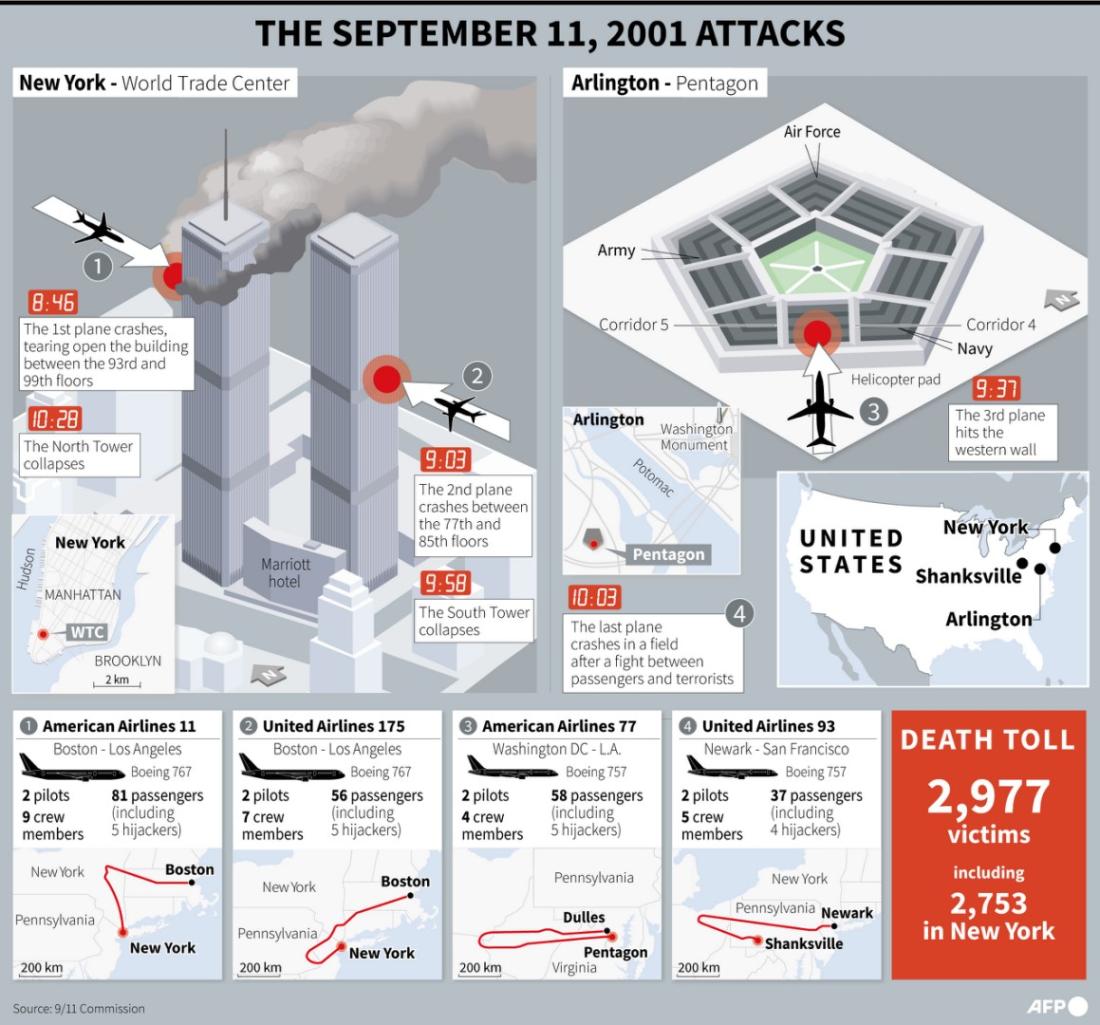
Nearly 3,000 people died in the September 11, 2001 attacks, during which Al-Qaeda devotees hijacked planes and flew them into New York City's World Trade Center and the Pentagon. A fourth jet crashed in the state of Pennsylvania after the passengers and crew fought back.
Conspiracy theories doubting the accepted version of events have spread for decades. But those theories have been repeatedly, widely and thoroughly debunked.
The claims invoking the March 2026 Air Canada accident are similarly baseless.
Aviation experts said it is misguided to draw conclusions about 9/11 from the LaGuardia crash, which involved a smaller aircraft moving much slower than the jets that took out the Twin Towers -- and which also did not generate an explosion.
"There is absolutely no rationale whatsoever to take any information from the crash at LaGuardia to support anything whatsoever that happened on 9/11," said Shawn Pruchnicki, an assistant professor at The Ohio State University's Center for Aviation Studies, who previously worked as an airline pilot and was trained in accident investigation (archived here).
"It's two completely different situations from a matter of kinetic energy, from speed of the collision, and the fact that there was no fire involved," he told AFP in a March 25 interview.
Kinetic energy
The National Transportation Safety Board is still investigating the collision at LaGuardia, the flight hub's first fatal accident since 1992.
According to Air Canada, the plane involved was an Air Canada Express Mitsubishi CRJ900 -- which has a maximum landing weight of approximately 75,100 pounds (34,065 kilograms) -- carrying 72 passengers and four crew members (archived here and here).
Video footage shows the aircraft touched down and was rolling on the runway when it barrelled into the fire truck (archived here). News organizations have reported varying speeds for the plane at impact, ranging from about 30 to 105 miles (48 to 169 kilometers) per hour.
"They were already slowing the airplane," said Pruchnicki, who added that the pilots would have likely also applied "maximum breaking."
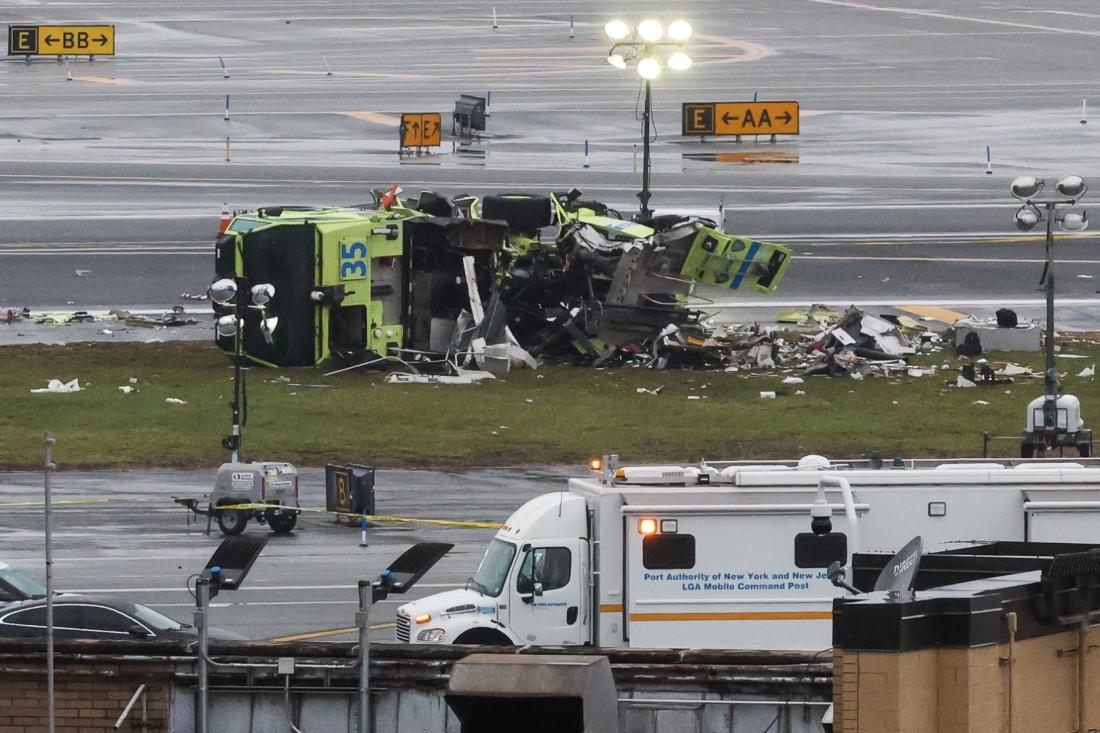
The heavy truck was badly damaged as it was flipped on its side and dragged across the tarmac. Two Port Authority firefighters inside were injured.
The jets that hit the Twin Towers on 9/11, by contrast, were Boeing 767 aircrafts, according to the 9/11 Commission Report released in 2004 (archived here) and the National Institute of Standards and Technology's report published a year later.
The NIST report estimated that the weight at impact of the American Airlines flight that hit the first tower was 283,600 pounds (128,638 kilograms). The jet was moving at about 440 miles (708 kilometers) per hour, the report said.
The second plane, operated by United Airlines, was similarly sized and traveling 540 miles (869 kilometers) per hour.
The "tremendous" difference in size and velocity relative to the LaGuardia crash would have translated to far more kinetic energy, the energy an object carries due to its motion, Pruchnicki said.
"From a kinetic energy standpoint, there is no comparison whatsoever between the two," he said. "The magnitude is astronomical."
He likened the situation to automobile accidents, where a bump from a small vehicle moving slowly would be significantly less catastrophic than a crash with a semi-truck at top speed.
Joris Melkert, a senior lecturer at the Delft University of Technology in the Netherlands, agreed that comparing 9/11 to the LaGuardia incident "does not make much sense."
"Kinetic energy goes up linear with the mass and quadratically with the velocity and thus the potential to do damage to the other object," Melkert said in a March 25 email. "I would not be surprised if the amount of energy involved in the WTC-case was in the order of 10 times higher than in the Air Canada case."
Fire
The posts citing the LaGuardia crash to question the Twin Towers' collapse also ignore the explosion of the hijacked planes' jet fuel, Pruchnicki said.
"The third component is the amount of fuel that was involved on 9/11, which was not a part, obviously, of LaGuardia," he told AFP. "That was significant and was the final factor that brought down the towers."
The planes commandeered by the Al-Qaeda hijackers sliced through the skyscrapers' glass windows and damaged structural components. But the 2005 NIST report said the towers "would have remained standing were it not for the dislodged insulation and the subsequent multi-floor fires."
The fires caused floors to sag and weakened the core columns until they failed, the report said.
"Eventually those structures, what few that were left, were no longer able to support the building above it, so the building pancaked," Pruchnicki said.
The NIST report also said there was "no corroborating evidence for alternative hypotheses" suggesting missiles or a controlled demolition had collapsed the towers, two arguments popular with conspiracy theorists.
AFP has previously debunked other misinformation about the 9/11 attacks here.
Copyright © AFP 2017-2026. Any commercial use of this content requires a subscription. Click here to find out more.
Is there content that you would like AFP to fact-check? Get in touch.
Contact us