Multiple factors behind fatal NZ landslide, not just tree removal: experts
- Published on February 6, 2026 at 08:44
- 3 min read
- By Dene-Hern CHEN, AFP Australia
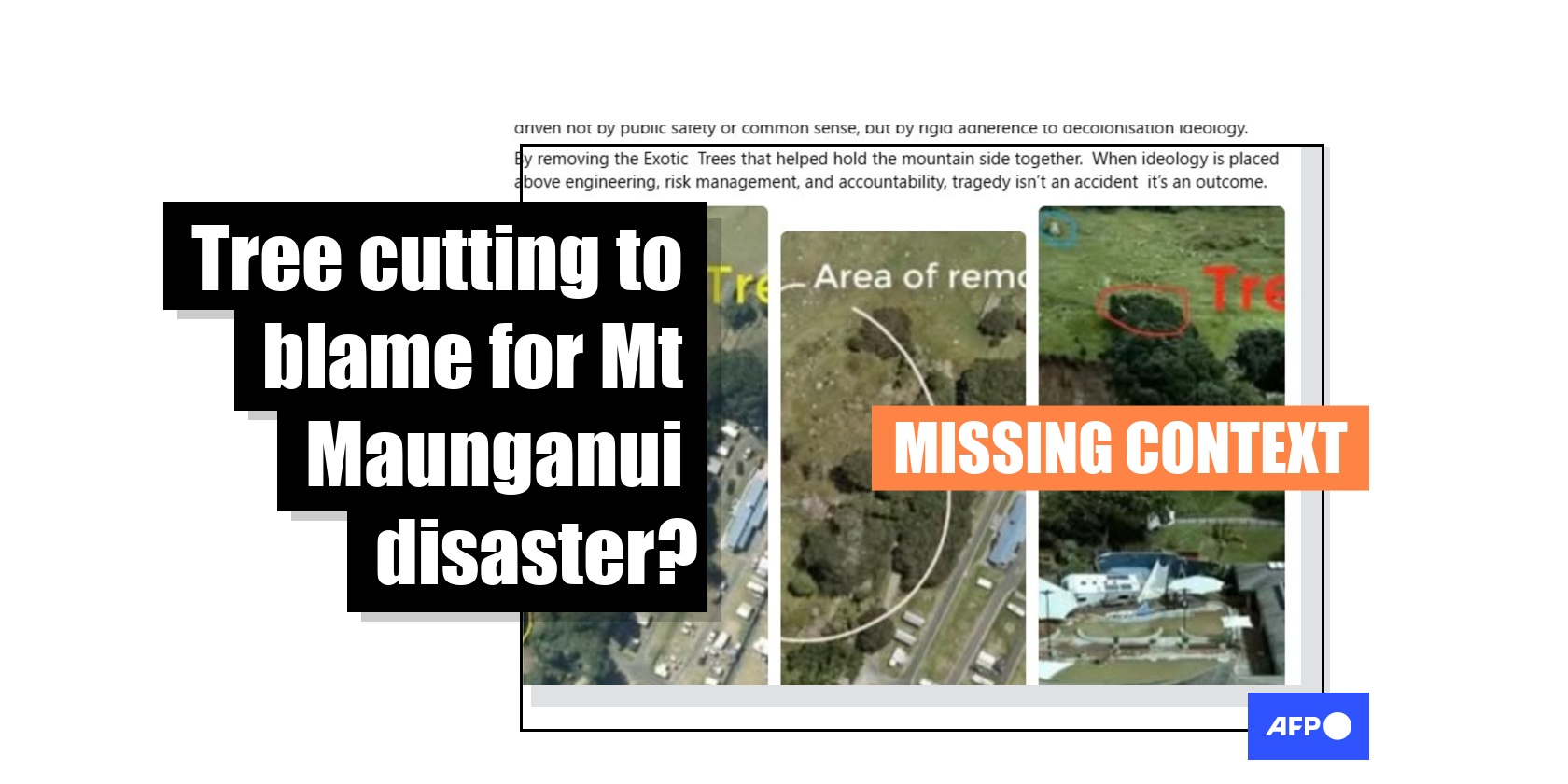
Authorities are probing the cause of a deadly landslide in northern New Zealand in late January, but experts have pushed back against claims online that the removal of trees by the city council and local iwi leaders -- Maori tribe -- was solely to blame. Eight trees were cleared from Mount Maunganui in 2023 but records from the time show they were destroyed by a cyclone or were deteriorating. Geologists told AFP multiple factors likely triggered the recent disaster and urged the public to wait for the results of the full investigation.
"The iwi leadership, Tauranga City Council and Mayor Drysdale share responsibility for the failures that led to the deaths of six people at Mount Maunganui," reads part of a January 25, 2026 Facebook post shared more than 180 times.
Posted three days after mud from the extinct volcano ploughed into a campsite and killed six people, it says authorities removed exotic trees that helped hold Mount Maunganui together (archived link).
"Their inaction and poor decision making were driven not by public safety or common sense, but by rigid adherence to decolonisation ideology."
An X post from January 23 also questioned if the removal of "eight large exotic trees" was a contributing factor to the fatal landslide.

Similar claims were shared elsewhere on Facebook, Threads and X as the New Zealand government announced that an independent review will look into "all aspects leading up to" the disaster (archived here and here).
New Zealand Prime Minister Christopher Luxon told local media on January 26 that he was aware of the online chatter (archived link).
"The people on the margins with their rhetoric, they just need to frankly keep it to themselves and focus on doing everything they can to support this community at this time," he said.
'Range of factors'
While eight non-native trees were removed in 2023 by the city council which oversees Mount Maunganui, a notice published on June 14, 2023, said several of the trees had fallen over during Cyclone Gabrielle months earlier, "pulling up their root plates and damaging the surrounding land" (archived here and here).
"A number of trees... are showing significant signs of deterioration and, if left unattended, could further damage the culturally and historically significant site they are sitting on," the notice said.
AFP reached out to the city council for comment, but did not receive a response at the time of publication.
Two experts also told AFP several factors likely contributed to the landslide and it is impossible at this stage to single out the removal of exotic trees for blame.
Mike Marden, a soils and landscapes expert at New Zealand's Bioeconomy Science Institute, said that while he is not an expert on the area, "from what limited footage I've seen, the depth of the slip exceeded the depth of the root systems of the Pohutukawa trees (a native tree species) and for that matter, any other tree species" (archived link).
"This wasn't a typical shallow landslide. The most recent slope failure is located within a larger, pre-existing deep-seated slump," he said in a January 27 email.
"It's common for ancient slope failures to reactivate under extreme condition, whether it be earthquakes or periods of extreme weather."
Marden added that it should be up to local experts to figure out what is likely to be a "combination of multiple factors that led to the triggering of this landslide".
Martin Brook, a professor of Applied Geology at the University of Auckland who has written about the historical complexities behind the slope failure, separately told AFP on January 27: "I don't think anyone at this stage could say it was those trees" (archived here and here).
"Nobody knows, and usually it's actually a range of factors that are at play, not just one."
The Bay of Plenty region -- where Mount Maunganui is located -- is an extinct volcanic dome, and Brook said volcanic soils are problematic because they become unstable and can lead to landslides after rainfall.
Brook said the area had seen about 200 mm of rainfall in the 24 hours leading up to the fatal landslide, comparing it to 2011 when the area was hit by Cyclone Wilma and Mount Maunganui saw 80 "mass movements" (archived here and here).

"Back then, that was only 108 mm of rain in 24 hours. This time...it was two and a half times the rain that they got during Wilma," he said. "It's simply a landslide-prone hill."
Copyright © AFP 2017-2026. Any commercial use of this content requires a subscription. Click here to find out more.
Is there content that you would like AFP to fact-check? Get in touch.
Contact us