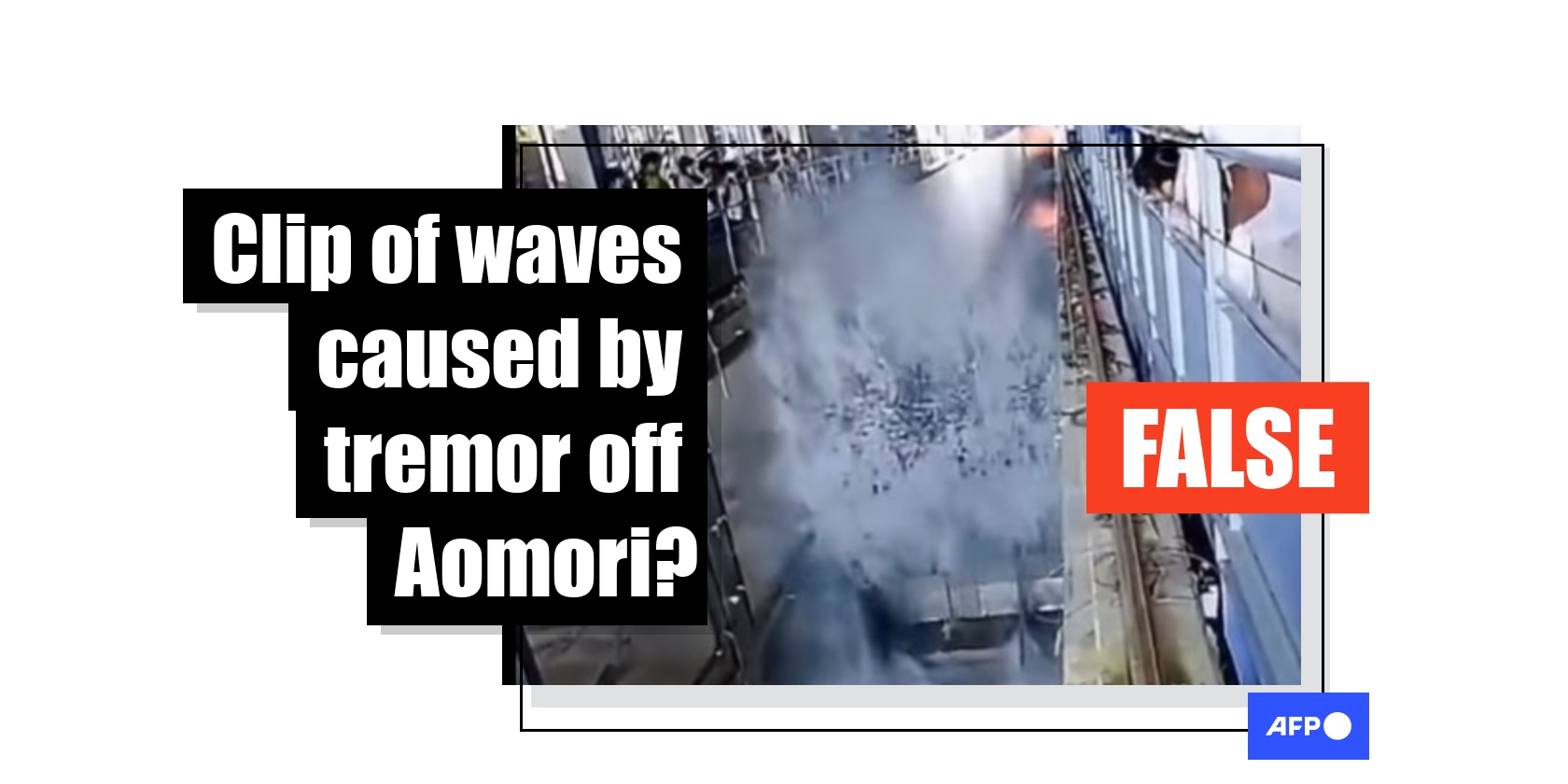
Old video shows tsunami experiment, not impact of northern Japan earthquake
- Published on December 10, 2025 at 07:49
- 2 min read
- By Najmi MAMAT, AFP Malaysia
A powerful magnitude 7.5 quake off Japan's northern coast triggered tsunami waves on December 8, but a clip circulating in Malay-language posts about the intensity of the tremor does not show its impact. The footage from 2013 shows a demonstration of a tsunami experiment at the Port and Airport Research Institute in the central prefecture of Kanagawa.
The video showing a group of people watching as a wave rolling along a drain-like structure gathers strength before crashing against a levee was shared on Facebook on December 8, 2025.
"A strong earthquake occurred off the east coast of Honshu, Japan at 10:15 pm, December 8, 2025," reads its Malay-language caption, adding there is "no tsunami threat" to Malaysia.
The post goes on to list details of the magnitude 7.5 quake that struck off the coast of the northern Aomori region at 11:15 pm (1415 GMT) that same day and injured 30 people (archived link).
The quake, which triggered tsunami waves up to 70 centimetres (28 inches), damaged roads and knocked out power for thousands in freezing temperatures.

The same video circulated alongside similar Facebook posts about the tremor.
The clip, however, is more than a decade old and does not depict the impact of a real earthquake.
A reverse image search using keyframes from the falsely shared clip led to a YouTube video uploaded on July 27, 2013 (archived link).
Its description states: "This is a video of tsunami experiment at Port and Airport Research Institute, Yokosuka, Kanagawa, Japan. The facility has annual open house event, and most of years, they show this tsunami experiment to visitors. This is the one done at July 27, 2013."
Kanagawa in central Japan is a coastal prefecture just south of the capital Tokyo.

According to its website, the Port and Airport Research Institute conducts research on disaster prevention and mitigation (archived link).
The Large Hydro-Geo Flume (LHGF), seen in the video, can generate waves of 3.5 metres and tsunamis of 2.5 metres (archived link).
According to the institute's website, "Small models cannot be used to verify the mechanism of a disaster striking breakwaters or seawalls, including ground motion and structure destruction. LHGF has enabled the use of nearly life-size models."
The institute has a video showing the flume in action, and also uploaded a similar photo of members of the public watching the tsunami wave experiment (archived here and here).

AFP has frequently debunked misinformation about tsunamis striking Japan.
Copyright © AFP 2017-2026. Any commercial use of this content requires a subscription. Click here to find out more.
Is there content that you would like AFP to fact-check? Get in touch.
Contact us