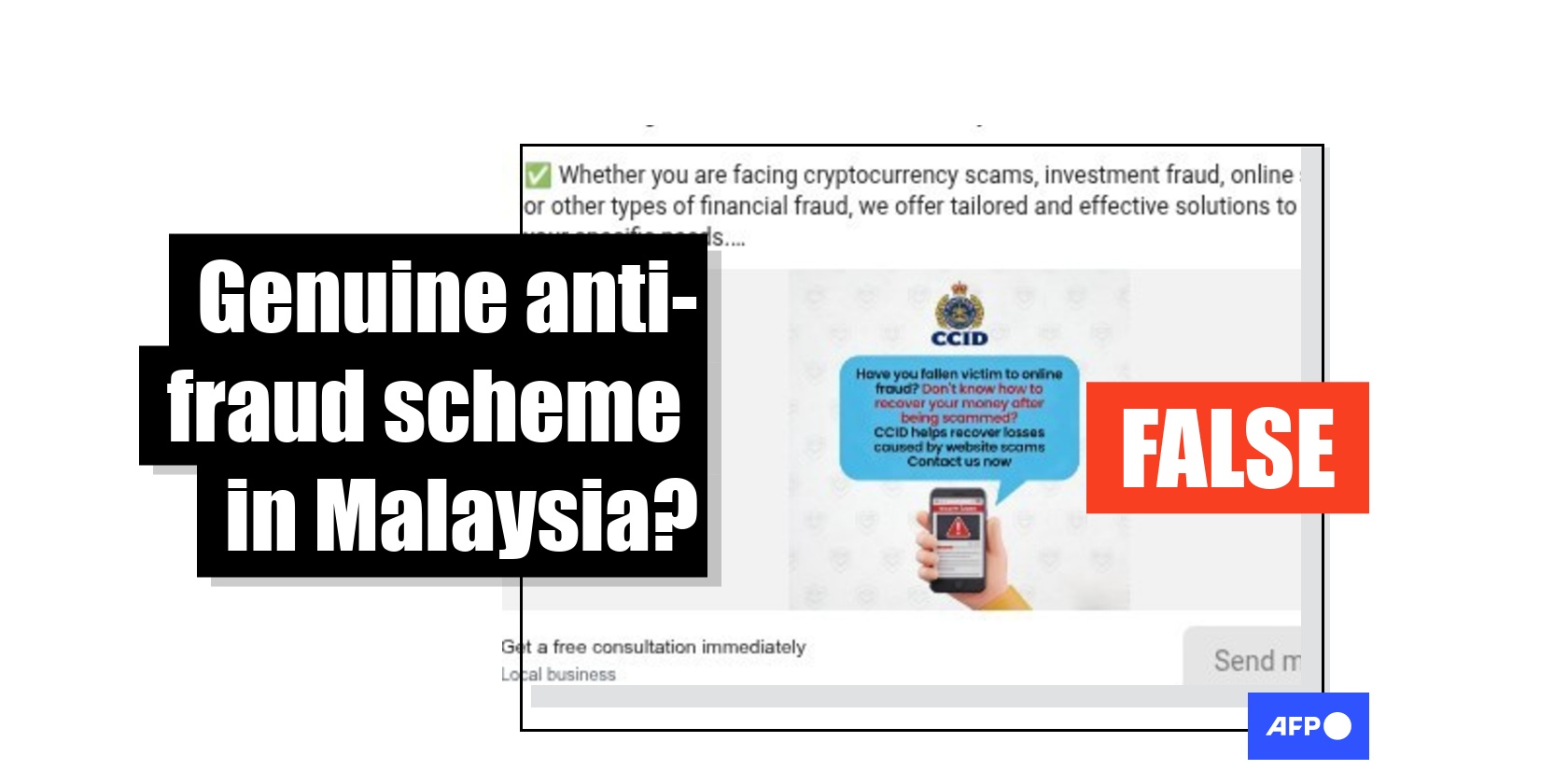
Online scammers pose as Malaysian police to promote money recovery service
- Published on February 5, 2026 at 04:42
- 2 min read
- By Najmi MAMAT, AFP Malaysia
Scammers in Malaysia are targeting victims of fraud with false money recovery services, posing online as anti-crime centre staff, police officers or legal firms. The imposters use private WhatsApp accounts to trick people into paying a service fee, but authorities warned such offers "aim to trap victims a second time". The country's anti-fraud agency says it may try and trace money lost to scams, but provides no guarantee losses can be recovered.
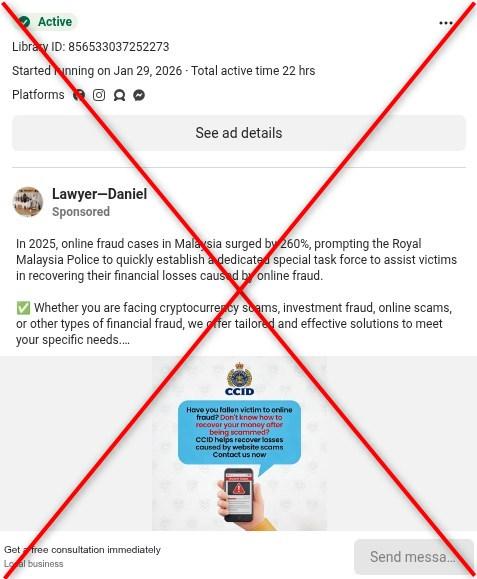
"Have you fallen victim to online fraud? Don't know how to recover your money after being scammed? CCID helps recover losses caused by website scams. Contact us now," reads a Facebook advertisement that was first shared on January 29, 2026.
The ad, also shared on Instagram and Facebook Messenger, suggests the service it provides for scam victims is supported by the Royal Malaysia Police's Commercial Crime Investigation Department (CCID).
An attached link leads users to Facebook Messenger accounts of supposed lawyers.
Dozens of Malay-language posts between November 2025 and January 2026 shared similar claims, and were accompanied by various images or graphics depicting current and former police officers.
These include Deputy Inspector-General of Police Ayob Khan Mydin Pitchay, former police secretary Noorsiah Mohd Saaduddin and former CCID officer Rahmat Fitri Abdullah. There were also posts impersonating the National Scam Response Center (NSRC).
Several accounts provide links to different WhatsApp phone numbers -- some using images of police officers as profile pictures -- where people can supposedly ask for more information.
AFP reached out to one of the numbers and was given an order form asking for personal details, including full name, type of scam case, amount of lost money and bank account details.
The purported officer promised to recover money lost to scams, but only after a processing fee of 350 ringgit (US$89) is paid.
'Unregistered, unaccredited'
The CCID labelled such services as a "scam" in a Facebook post on January 29 (archived link).
"Most of these parties are unregistered, unaccredited, and aim to trap victims a second time, often by demanding advance payments," reads the Malay-language post.
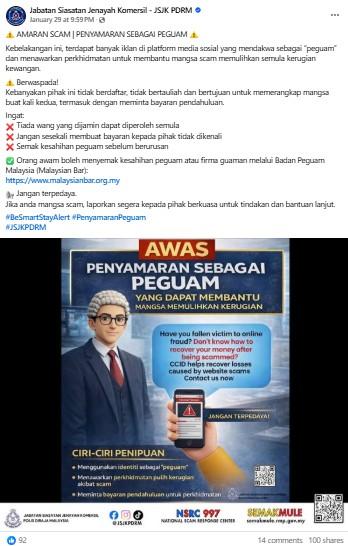
The post reminds users there is no guarantee money lost to scams can be recovered, and urges them to verify the legitimacy of a lawyer through the Malaysian Bar Association.
It adds authorities do not use private or personal WhatsApp accounts or request any payments from victims in order to carry out an investigation or recover lost funds.
The NSRC website separately advises victims to notify their bank or its 997 hotline, and then file a police report as soon as fraud is detected (archived link).
"There is no guarantee that you will get your money back," it states, adding the agency will coordinate a response from law enforcement agencies, financial institutions and telecommunications service companies.
Authorities will only contact victims who have already made a fraud incident report, and will not ask for personal banking information, such as usernames, passwords, PINs or one-time passwords.
AFP reached out to the CCID chief Rusdi Isa for further comment, but a response was not forthcoming.
AFP has repeatedly debunked scam posts posing as various authorities, offering to provide purported passport and visa application services and "test-free driving licences", as well as deepfake videos of Malaysian royals offering "cash aid" on social media.
Copyright © AFP 2017-2026. Any commercial use of this content requires a subscription. Click here to find out more.
Is there content that you would like AFP to fact-check? Get in touch.
Contact us