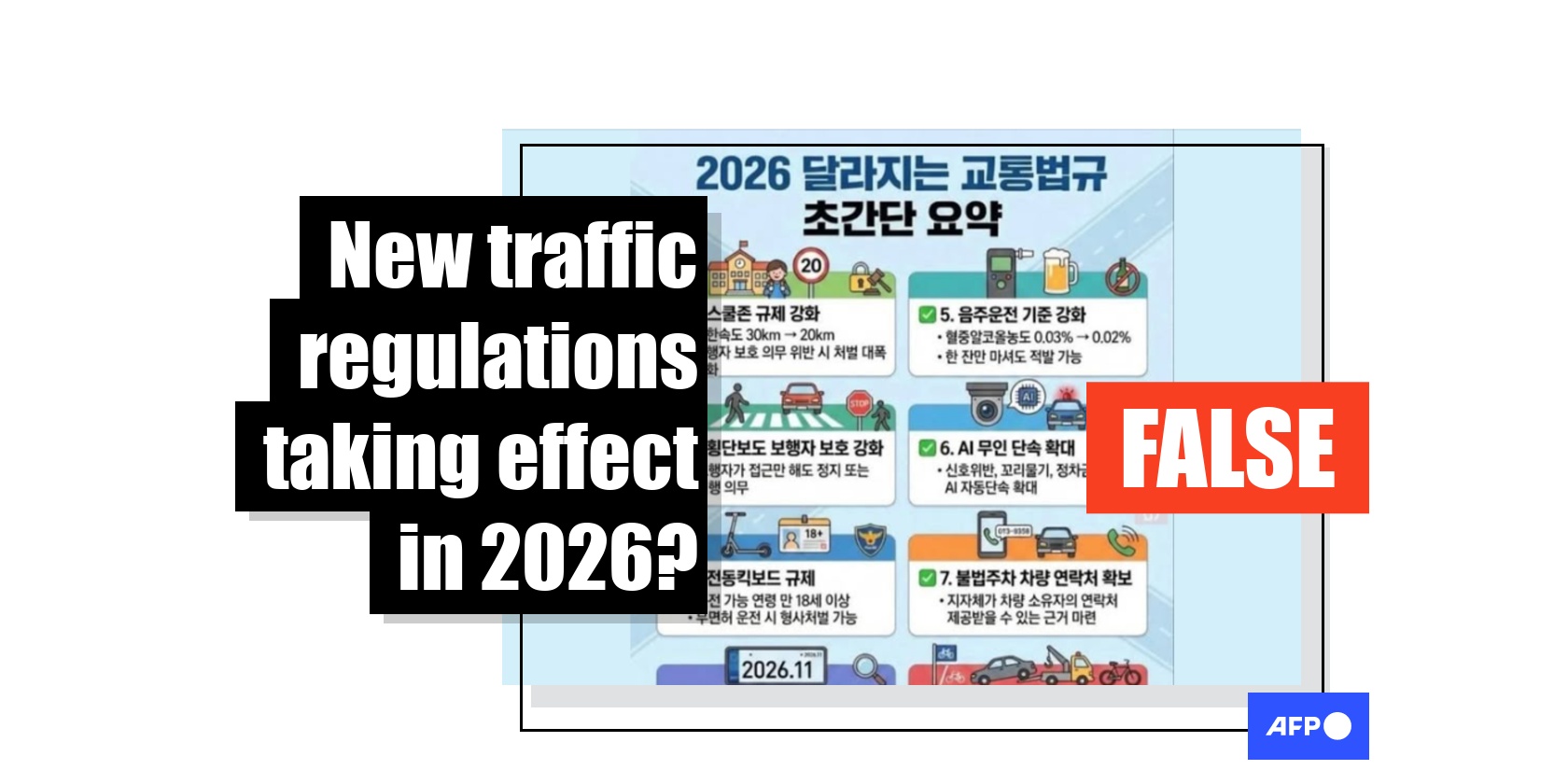
Posts falsely claim sweeping traffic law changes in South Korea for 2026
- Published on December 23, 2025 at 08:35
- 2 min read
- By Hailey JO, AFP South Korea
South Korean police have refuted claims shared on social media that a raft of new traffic regulations -- including lower speed limits in school zones and an increased minimum age for e-scooters -- would take effect in 2026. The claims spread as official statistics showed an increase in accidents in school zones in recent years, but the police refuted the claims about the purported changes. There have also been no official reports, records or announcements about these supposed regulations.
"A quick summary of traffic law changes for 2026," reads a Korean-language Instagram post shared on December 11, 2025.
The post features a graphic listing a series of purported new rules, including lower school zone speed limits, stricter drunk-driving laws and tougher penalties.
It says school zone speed limits would be "reduced from 30 km/h to 20 km/h", and penalties for breaching pedestrian protection rules would be "significantly strengthened".
Automated traffic enforcement using devices powered by artificial intelligence will also be expanded, according to the graphic.

The graphic was also shared in similar Facebook, Threads and X posts, while similar claims about new traffic regulations circulated on Instagram and Naver Blog.
"This is getting ridiculous. People are already saying 30 km/h is too slow, and now 20 km/h?" read a comment on one of the posts.
Another said, "Next they will probably tell us to get out and push the car."
The number of traffic accidents in school zones as well as those involving e-scooters and other types of personal mobility vehicles has risen in recent years in Seoul, according to official statistics (archived here and here).
In February 2024, the Seoul city government imposed a 20 km/h speed limit -- below the standard limit for school zones -- on 50 additional accident-prone areas near schools (archived link).
Experts have urged authorities to mull stricter regulations for e-scooters (archived link).
The purported changes to traffic laws, however, have neither been approved nor are they being planned.
Many of them, such as raising the minimum age for e-scooters, lowering the blood alcohol level limit, mandating unconditional stops at all crosswalks and shortening the licence renewal cycle for senior drivers, would require legal amendments.
A review of more than 100 proposed revisions to the Road Traffic Act submitted during the current parliamentary term found no such amendments (archived link). AFP also found no official reports or records to back the claim.
South Korea's National Police Agency also refuted the claim in a December 16 statement, saying the purported changes were "neither planned nor under way" (archived link).
The force said some parts, such as those regarding pedestrian protection, AI-powered automated enforcement and bike lane regulations, are "partly false".
Motorists are not required to stop unconditionally at all crosswalks -- contrary to false posts -- but they must stop at crossings without signals in school zones, regardless of whether pedestrians are present.
The police also said there were no plans to expand the use of AI monitoring devices, which is currently limited to detecting speeding, traffic signal violations and expressway bus-only lane violations, with tailgating enforcement being piloted in Seoul.
They added that cars illegally parked on bicycle lanes would not be immediately towed away -- but it could also depend on each local government's ordinances, enforcement capacity and the extent of traffic obstruction.
AFP previously debunked a similar false claim about Australian traffic rules.
Copyright © AFP 2017-2026. Any commercial use of this content requires a subscription. Click here to find out more.
Is there content that you would like AFP to fact-check? Get in touch.
Contact us